
Why Is the Prop Firm Industry Growing So Fast in 2026?

Why Is the Prop Firm Industry Growing So Fast in 2026?
The proprietary trading industry is no longer a small corner of retail trading.
In 2026, prop firms are attracting millions of traders, major brands are expanding into new markets, established firms are buying brokerage businesses, and the industry is beginning to build its own standards for transparency and dispute resolution.
The numbers help explain the scale of the change.
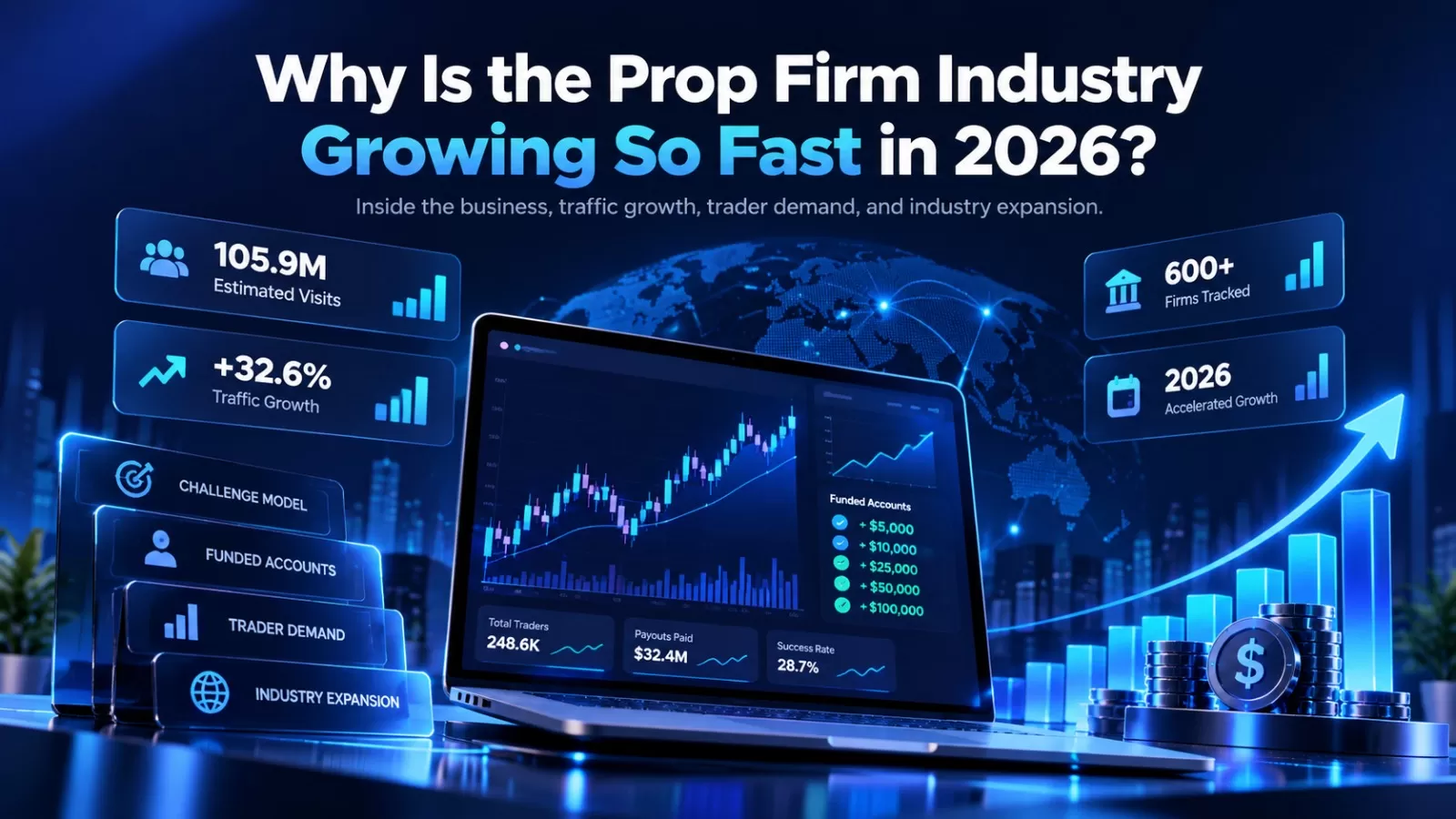
According to Prop Firm Pal’s August 2026 traffic report, more than 600 prop firm websites were being tracked, with an estimated 105.9 million visits during August 2026.
Even more importantly, when comparing the same 244 websites consistently measured since November 2025, estimated traffic increased by 32.6% by August 2026.
These figures do not mean that 105.9 million individual traders are using prop firms. Website traffic is not the same as customer numbers, funded accounts, or company revenue.
But the trend is difficult to ignore.
Prop trading has become one of the most visible segments of the retail trading industry.
So why is the prop firm business growing so quickly?
The answer is not one single factor.
It is a combination of accessibility, psychology, marketing, technology, and the changing economics of retail trading.
1. Traders Want Access to More Capital
This is probably the most obvious reason.
A retail trader might have the skill or confidence to trade, but only have $500, $1,000, or $5,000 available as personal trading capital.
Even if that trader earns 5% in a month, the dollar return may still feel relatively small.
Prop firms changed that perception.
Instead of requiring traders to deposit tens of thousands of dollars, firms began offering evaluation programs connected to much larger simulated account sizes.
A trader might pay a relatively small challenge fee and attempt to qualify for an account presented as $25,000, $50,000, $100,000, or more.
That creates a powerful proposition:
Risk a relatively small fee for access to a much larger trading opportunity.
Whether a trader ultimately succeeds is another matter.
But from a marketing perspective, the model is highly attractive.
2. Prop Trading Removes One of Retail Trading’s Biggest Barriers
Traditional trading has always had one major problem:
Capital.
Imagine two traders with exactly the same strategy.
One has $1,000.
The other has $100,000.
Even if they achieve exactly the same percentage return, their financial outcomes are completely different.
Prop firms effectively built a business around solving, or at least appearing to solve, that problem.
Instead of asking:
How much money do you have?
The model asks:
Can you demonstrate that you can trade within our rules?
That change helped open the market to an enormous audience of traders who could never realistically fund a large brokerage account themselves.
3. The Challenge Model Is Highly Scalable
Prop firms also have an important business advantage.
Many modern retail prop programs operate primarily in simulated trading environments.
That makes the business structurally different from a traditional brokerage or traditional proprietary trading desk.
A company can potentially sell evaluation programs to customers in many countries without assigning the advertised account size as real trading capital to every participant.
That makes the model highly scalable.
A firm can offer thousands of evaluations without needing to place an equivalent amount of capital into live brokerage accounts for every trader.
The economics are one major reason so many companies entered the industry.
Prop Trade Center’s H1 2026 research identified 14 qualifying new prop firm launches during the first six months of the year.
Its researched dataset also identified two acquisitions, two strategic investments, and two integrations during the period.
The study explicitly warns that these figures should not be interpreted as a complete global count of every firm in the industry.
Still, they demonstrate that new businesses continue to enter the sector.
4. Social Media Changed How Traders Discover Prop Firms
Prop firms are almost perfectly designed for modern social media marketing.
Consider the type of content traders regularly see:
-
$100,000 funded account
-
$5,000 payout received
-
Challenge passed in three days
-
First withdrawal
-
90% profit split
-
Instant funding
-
No time limit
-
Discount code
-
Free retry
-
Payout certificate
These messages are simple, visual, and easy to distribute through TikTok, YouTube, Instagram, X, Telegram, and Discord.
Traditional brokers usually have a more complicated marketing message.
A broker may need to explain spreads, commissions, regulation, execution, liquidity, and account types.
A prop firm’s marketing message can often be reduced to:
Pass the challenge. Get funded. Earn a payout.
That simplicity gives prop firms a significant marketing advantage.
5. Affiliates Have Accelerated the Growth
Affiliate marketing has played an enormous role in the prop industry.
Trading influencers, educators, YouTubers, comparison websites, and community owners can receive commissions for referring traders to challenge programs.
The economics can be attractive because traders may purchase challenges repeatedly.
This creates a powerful acquisition engine:
Trader discovers a firm → Creator receives a referral commission → Firm acquires a customer → Customer may purchase another evaluation
That cycle can repeat across large communities.
It is one reason prop firm content has become so common across retail trading media.
6. Traders Can Try Again After Failure
This part of the business model is especially important.
In traditional trading, losing an account can mean losing the actual trading capital.
With many prop evaluation programs, failure usually means losing the challenge fee rather than the advertised account balance.
A trader can then purchase another evaluation and try again.
From the trader’s perspective, this can make the downside feel psychologically smaller.
For the prop firm, it can create recurring revenue.
That does not automatically mean the model is unfair.
But traders should understand the economics.
A trader who repeatedly buys challenges can eventually spend a significant amount of money without ever reaching meaningful payouts.
The correct calculation is therefore not simply:
How much does one challenge cost?
It should be:
How much have I spent across all evaluations compared with how much I have actually withdrawn?
That number gives a much clearer picture of whether prop trading is financially working for the individual trader.
7. The Biggest Prop Firms Are Becoming Very Large
The industry is also becoming increasingly concentrated.
Prop Firm Pal estimates that the 10 most visited prop firm websites accounted for approximately 59% of all tracked visits in August 2026.
The most visited sites included brands such as:
-
Funding Pips
-
FTMO
-
FundedNext
-
Topstep
-
Take Profit Trader
-
The5ers
Seventeen tracked websites exceeded an estimated one million monthly visits during August.
Again, traffic does not equal customers or revenue.
But it does demonstrate how much attention the largest prop brands are receiving.
At the same time, the median firm in the same dataset received only around 13,700 estimated monthly visits.
This tells us something important:
The prop industry may be growing overall, but success is not evenly distributed.
A small group of major brands controls a large share of trader attention.
8. FTMO Buying OANDA Changed the Conversation
One of the strongest signals that prop trading has matured came from FTMO.
FTMO started as a modern prop trading business.
It later became large enough to acquire OANDA, one of the most established names in global online brokerage.
The acquisition was completed on December 1, 2025, after regulatory approvals.
FTMO said the transaction formed part of its plan to build a broader trading group combining modern prop trading, traditional brokerage, and related services.
The exact transaction value was initially undisclosed.
Financial information reported in September 2026 later indicated a price of roughly $422 million.
That is an extraordinary development for an industry that many traders still think of as a collection of websites selling trading challenges.
FTMO now operates in a group containing both modern prop trading and a major regulated brokerage business.
Importantly, the businesses remain structurally distinct.
FTMO continues to describe its prop trading environment as simulated, while OANDA provides regulated live brokerage services through its relevant entities.
Why does this distinction matter?
A prop account and a regulated brokerage account are not legally or operationally the same thing.
9. Prop Firms Are Moving Beyond Forex and CFDs
Another major development is diversification.
The industry originally became heavily associated with forex and CFD trading.
That is changing.
Futures prop trading has become a major segment of the market, particularly in the United States.
FTMO officially announced its expansion into the futures market in September 2026 with the launch of FTMO Futures.
Other firms have also built businesses specifically around futures.
This gives traders more choice and gives prop companies access to additional customer segments.
The industry is gradually becoming broader than simply:
Forex Challenge → MT5 → Funded Account
10. Technology Made Launching a Prop Firm Easier
Years ago, building a trading company required significant infrastructure.
Today, companies can access third-party technology for:
-
Trading dashboards
-
Challenge tracking
-
Risk monitoring
-
CRM systems
-
KYC
-
Payment processing
-
Affiliate tracking
-
Account provisioning
-
Trading platforms
-
Payout management
That significantly lowers the barrier to entry.
A company no longer needs to build every component internally.
This has helped new prop firms launch quickly.
But it creates another risk.
A professional-looking website does not necessarily mean a company has strong finances, risk management, or governance.
The technology required to launch a prop brand can be easier to obtain than the infrastructure required to operate a sustainable financial business.
That is one reason traders should evaluate the company behind the website—not simply the design of the website.
11. Competition Is Making Challenges More Attractive
Prop firms are competing aggressively for traders.
That competition has resulted in:
-
Lower challenge prices
-
Frequent discount codes
-
Higher advertised profit splits
-
Fewer minimum trading days
-
More flexible trading rules
-
Larger account sizes
-
Faster payout cycles
-
Instant funding models
-
Free retries
-
Multiple challenge structures
From the trader’s perspective, competition can improve pricing and choice.
From the firm’s perspective, however, aggressive offers can create pressure on margins and risk controls.
That means:
The cheapest challenge is not automatically the strongest firm.
A sustainable firm needs enough revenue and risk-management capability to continue honoring legitimate payouts over time.
12. Regulation and Industry Standards Are Starting to Catch Up
One of the biggest weaknesses of the prop sector has historically been the absence of a consistent regulatory framework.
Many prop programs do not operate as traditional brokers and therefore may not fall under the same regulatory structure as firms holding customer trading deposits.
That has created confusion among traders.
In July 2026, the Financial Commission launched a voluntary certification framework specifically for proprietary trading firms.
The framework focuses on areas including:
-
Clear trading rules
-
Consistent enforcement
-
Transparent payout policies
-
Responsible risk management
-
Dispute resolution
Certified firms are also subject to ongoing monitoring and annual renewal.
However:
Voluntary certification is not government regulation.
Traders should not treat voluntary certification as equivalent to being regulated by a statutory financial regulator.
Still, its existence demonstrates that the industry has become large enough for demand for independent standards and dispute mechanisms to increase.
13. Traders Are Becoming More Selective
The first phase of the prop boom was heavily focused on account size.
Traders asked:
Who offers the biggest account?
That is changing.
More experienced traders increasingly ask:
-
Does the firm actually pay?
-
How long has it operated?
-
Are the rules clear?
-
Can rules change after purchase?
-
What happens during news?
-
Is consistency required?
-
Are EAs allowed?
-
Is copy trading allowed?
-
What happens after a large profit?
-
How are disputes handled?
-
What company legally operates the program?
-
Is trading simulated or live?
That change is important for the industry.
As traders become better informed, firms face greater pressure to compete on credibility, transparency, and clarity, rather than simply offering larger numbers.
The Prop Firm Industry Still Has Serious Risks
Rapid growth should not be confused with safety.
The prop model still contains significant risks for traders.
Firms Can Fail
A prop firm is a business.
Businesses can run out of money, lose payment providers, lose platform access, or shut down.
Payout Rules Can Be Complicated
Some firms include rules relating to:
-
Consistency
-
News trading
-
Maximum position size
-
Prohibited strategies
-
Copy trading
-
IP addresses
-
Device usage
-
High-frequency trading
-
Gambling-style behavior
A trader can be profitable and still violate a rule.
Simulated Capital Is Not Your Money
A $100,000 prop account generally should not be understood as the equivalent of having $100,000 deposited into a personal brokerage account.
Many modern prop programs operate using simulated capital.
The economic relationship is fundamentally different.
Discounts Can Encourage Overtrading
Constant promotions can make repeatedly buying challenges feel inexpensive.
But:
Ten failed $100 challenges still cost $1,000.
Traders should calculate their total lifetime challenge spending.
Large Firms Are Not Automatically Safe
Website traffic, social media popularity, and company size can indicate market presence.
They do not guarantee future payouts or financial stability.
Due diligence remains necessary.
Is the Prop Firm Boom Sustainable?
The answer will probably differ between companies.
The overall demand for capital-efficient trading opportunities appears strong.
Website traffic remains substantial.
New firms continue to launch.
Established companies are expanding.
Some major operators are moving into brokerage, futures, and other trading infrastructure.
At the same time, the market is becoming more competitive.
That usually leads to consolidation.
Smaller or poorly managed firms may struggle while larger companies gain more market share.
The most important signal may therefore not be how many prop firms exist.
It may be:
How many strong, sustainable prop firms remain after the industry matures.
The Next Phase of Prop Trading
The first phase of modern prop trading was about challenges.
The next phase may be about ecosystems.
We are already seeing companies combine:
Prop Trading + Brokerage + Futures + Technology + Education + Affiliate Networks
FTMO’s acquisition of OANDA is one example of this broader direction.
FTMO describes its broader strategy as building a global trading group covering modern prop trading, brokerage, and related services.
If other major firms follow similar strategies, the line between prop firms, brokers, and trading technology companies could become increasingly blurred.
PaidRebate View
The growth of prop trading is not difficult to understand.
It offers traders something traditional brokerage accounts cannot easily provide:
The possibility of pursuing larger trading rewards without personally depositing the equivalent advertised account size.
That proposition is extremely attractive.
Technology made the model scalable.
Social media made it easy to market.
Affiliates made customer acquisition faster.
Competition made challenges cheaper and more flexible.
And millions of traders around the world were already searching for access to larger trading capital.
Together, those factors created one of the fastest-moving sectors in retail trading.
But the industry is also entering a more mature phase.
Traders are demanding clearer rules.
Large firms are consolidating.
Independent standards are emerging.
And some prop firms are evolving into broader financial and trading groups.
For traders, the opportunity is real, but so is the need for due diligence.
Before purchasing any challenge, traders should understand exactly:
-
What they are buying
-
What rules apply
-
How payouts work
-
What happens if rules are violated
-
Whether trading is simulated or live
-
Who legally operates the company
The prop firm industry may continue growing.
The more important question now is:
Which firms will still be trusted when the industry finishes growing up?
A passionate writer and content creator.
Frequently Asked Questions
Account Management
Questions about managing your PaidRebate account.
Getting Started with Trading
Basic questions about starting your trading journey.
Payments and Withdrawals
Information about rebate payments and withdrawal process.
Trading Support
Questions about trading platforms and technical support.
Community Comments
Please log in to comment on this blog post.
Log InNo comments yet. Be the first to comment!