
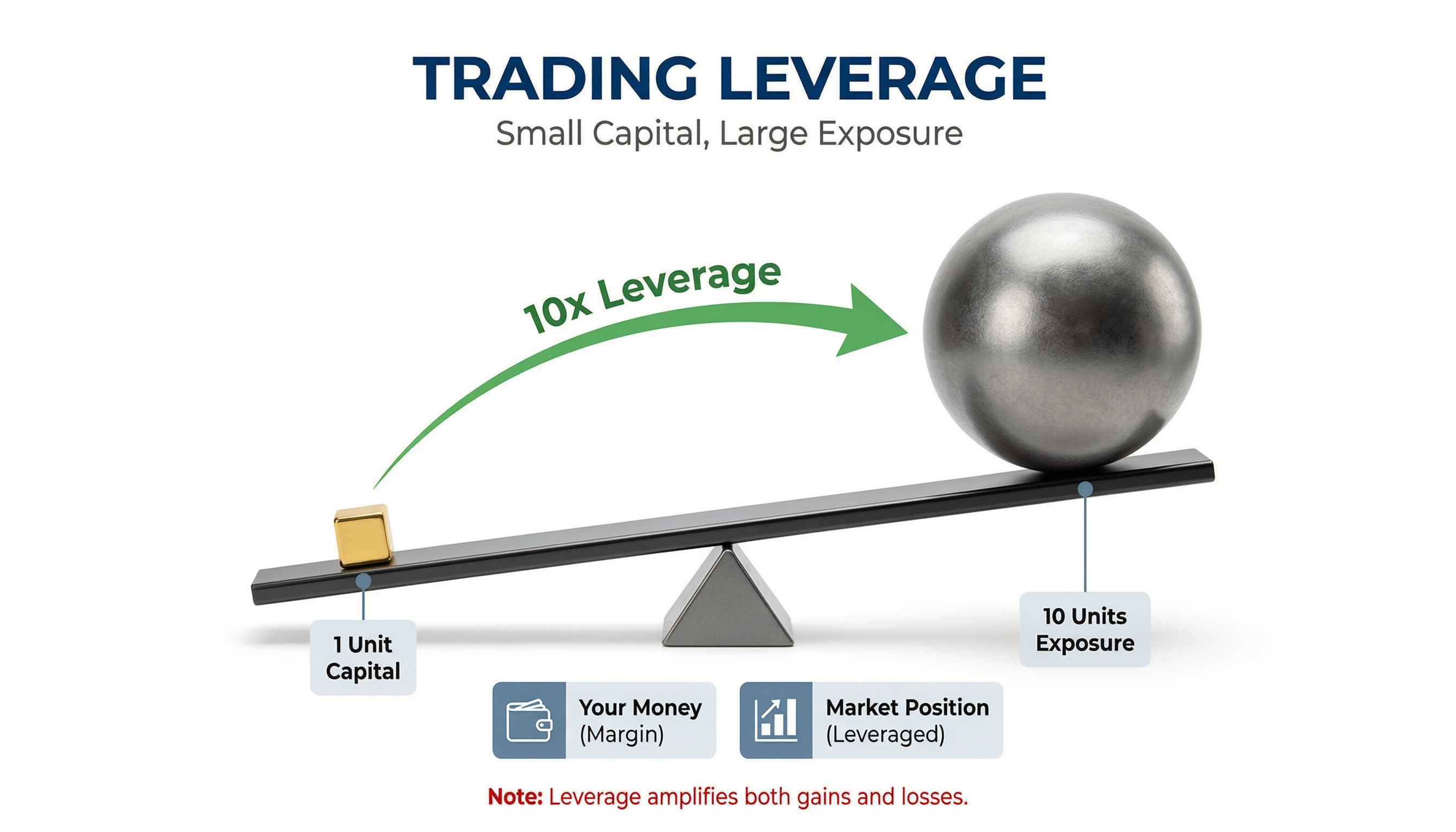
How Leverage Works
Leverage allows you to control a large position with a relatively small amount of capital. With 100:1 leverage, you can control $100,000 worth of currency with just $1,000 in your account. Leverage is expressed as a ratio — 50:1 means you can control a position 50 times the size of your margin deposit. This amplification effect is what makes forex trading accessible to retail traders with limited capital. Without leverage, a $1,000 account could only trade micro lots, making it nearly impossible to generate meaningful returns. With leverage, that same account can trade standard lots and participate in the same markets as institutional traders.
However, leverage is a double-edged sword that must be respected. While it magnifies potential profits, it equally magnifies losses. A 1% move against you with 100:1 leverage means losing your entire account. A 2% move with 50:1 leverage wipes out all your capital. This mathematical reality is why most professional traders use very low leverage — typically 5:1 to 10:1. They understand that high leverage is not a tool for increasing profits but a risk multiplier that can destroy an account faster than almost any other factor. The seductive promise of turning small money into large gains quickly has led more traders to ruin than any other single factor in forex trading.
The Double-Edged Sword
Consider a concrete example. Trader A uses 5:1 leverage and risks 1% of a $10,000 account per trade. Trader B uses 50:1 leverage and risks 5% per trade because they want to maximize returns. In a 10-trade losing streak — a scenario that any trader can and will experience — Trader A loses approximately $956 and still has over $9,000 remaining. Trader B loses nearly 50% of their account, dropping to approximately $5,987 — requiring a 67% gain just to break even. This is the hidden danger of high leverage: it turns normal losing streaks into catastrophic drawdowns from which recovery is extremely difficult. The math does not lie — lower leverage is one of the most powerful advantages a trader can maintain.
Margin Explained
Margin is the amount of money required to open and maintain a leveraged position. It is not a fee or a cost — it is a deposit held by your broker as collateral to cover potential losses. A $10,000 position with 50:1 leverage requires $200 margin (1/50th of the position size). Your broker monitors your margin level in real time, calculated as Equity divided by Used Margin, expressed as a percentage. If your margin level falls below the broker's requirement — typically 100%, meaning your equity equals your used margin — you cannot open new positions. If it falls to the stop-out level (often 50% to 80%), your broker will automatically close your weakest positions to protect themselves from further losses. This is called a margin call or stop-out, and it is one of the most painful experiences a trader can face — watching your broker liquidate positions at the worst possible prices while you are powerless to stop it.
Safe Leverage Guidelines
- Use leverage of 10:1 or less for most trades — this keeps your risk manageable and ensures that normal market fluctuations do not threaten your account survival. High leverage is a trap, not an advantage.
- Keep at least 3x the required margin as free margin — free margin is the money available to open new positions. Having substantial free margin gives you buffer against temporary drawdowns and prevents margin calls during adverse price movements.
- Reduce leverage during high-impact news events — spreads widen and volatility spikes during NFP, FOMC decisions, and other major releases. Even lower leverage can feel dangerous during these events. Consider reducing position sizes by 50% before known high-impact events.
- Never increase leverage to compensate for losses — the temptation after a losing streak is to trade larger to recover faster. This is the death spiral of trading. Stick to your plan and accept that losses are part of the process. Increased leverage during emotional periods leads to catastrophic outcomes.
- Calculate your effective leverage before every trade — divide your total position size by your account equity to determine your actual leverage. If you have a $5,000 account and open a $50,000 position, your effective leverage is 10:1. Keep this number well within your comfort zone.
Conclusion
Leverage and margin are powerful tools that enable retail traders to participate in the forex market with limited capital. However, they must be used with extreme caution and respect. The safest approach is to use low leverage (10:1 or less), maintain ample free margin, and never increase position sizes to recover losses. Understand that leverage does not make you a better trader — it amplifies whatever results your strategy produces, both good and bad. Master risk management first, and treat leverage as a privilege to be used sparingly, not a gift to be exploited. Your trading career will be measured in years and decades, and conservative leverage use is essential for longevity in the markets.

A passionate writer and content creator.
Community Comments
Please log in to comment on this blog post.
Log InNo comments yet. Be the first to comment!