
Trend Following Strategy: How to Profit from Market Momentum

Why Trend Following Works
Trend following is based on a simple observation: markets tend to move in persistent directions. By identifying and following trends, you align yourself with the dominant market force. The logic is straightforward — if the market is moving in a particular direction, it is likely to continue moving in that direction until something significant changes. Trend following does not try to predict market tops or bottoms; instead, it aims to capture the middle portion of a trend where the majority of price movement occurs. This approach has been validated across decades of market history and works in virtually every liquid market, from forex and stocks to commodities and crypto.
The strategy's effectiveness stems from basic human psychology. Trends form because traders react to price movements with herding behavior — when prices rise, more buyers are attracted, driving prices higher. This self-reinforcing cycle can persist for extended periods, creating substantial directional moves that trend followers capture. Trend following is not about being first or catching the exact turning point. It is about recognizing that a trend has established itself and joining it with the understanding that you will enter after the initial move and exit before the final reversal. Accepting this trade-off — giving up the first and last parts of the move in exchange for capturing the reliable middle — is the key to trend following success.
Identifying a Trend
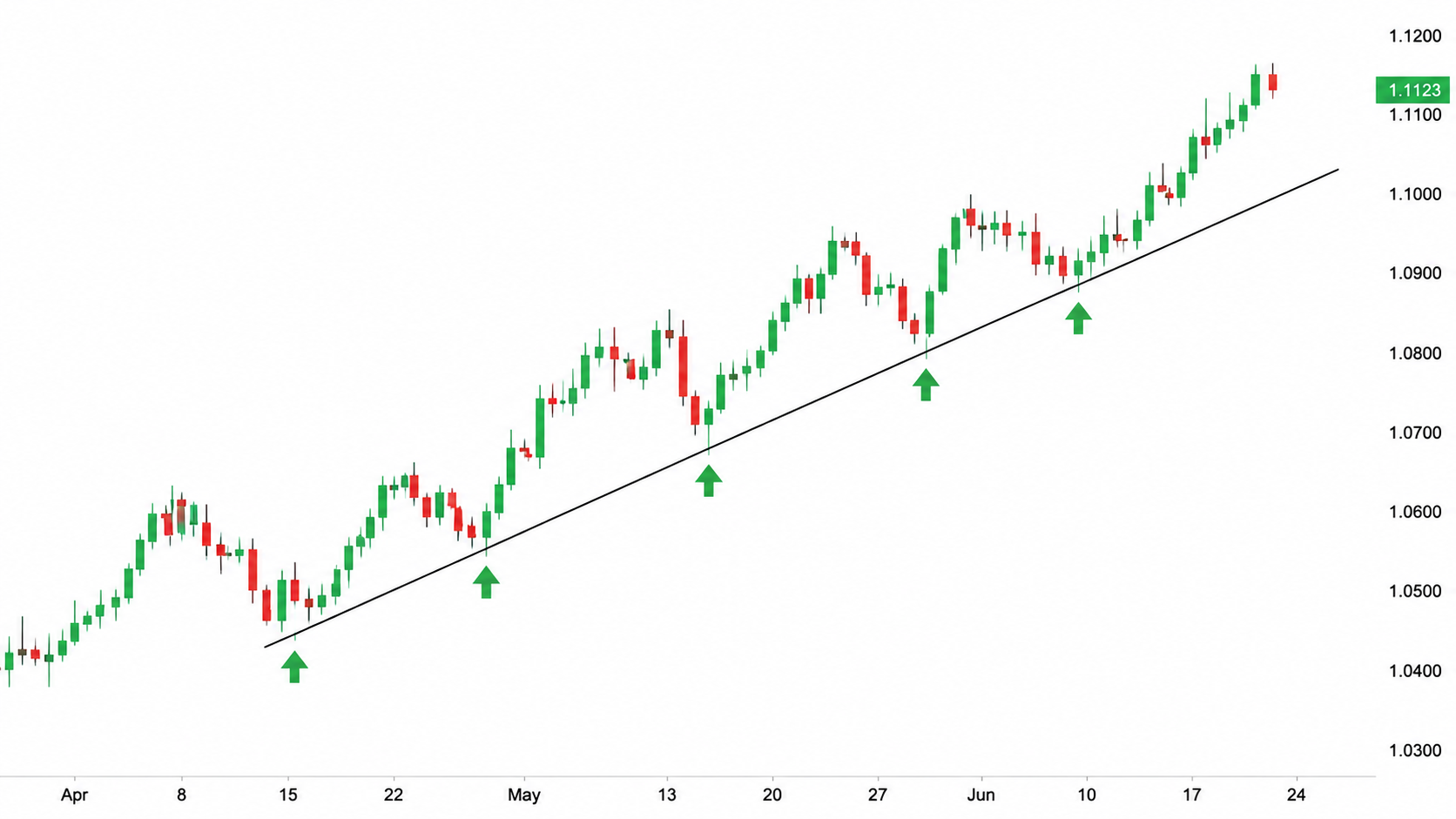
Use higher timeframes (daily, 4-hour) to determine the overall direction. An uptrend consists of higher highs and higher lows — each successive peak is higher than the previous one, and each pullback holds above the previous low. A downtrend consists of lower highs and lower lows — each rally fails to exceed the previous peak, and each decline breaks below the prior trough. This market structure analysis is more reliable than any single indicator for determining trend direction. Once you identify the dominant trend, the golden rule of trend following applies: trade only in the direction of that trend. Fighting the trend is one of the costliest mistakes traders make.
Moving averages provide additional confirmation. When price is above the 200-day SMA, the long-term trend is bullish. When below, it is bearish. The 50-day SMA acts as an intermediate trend filter, and the 20 EMA provides short-term trend guidance. When all three align — price above 20 EMA, which is above 50 SMA, which is above 200 SMA — you have a strong multi-timeframe uptrend. The opposite alignment signals a strong downtrend. Use these tools in combination with market structure analysis for the most reliable trend identification.
Entry Techniques
- Buy pullbacks to key moving averages — in an uptrend, price often pulls back to the 20 EMA or 50 SMA before resuming higher. Enter on the pullback with a stop below the moving average or the recent swing low. This approach gives you better risk-reward than chasing breakouts.
- Enter on trendline bounces — draw a trendline connecting the swing lows in an uptrend (or swing highs in a downtrend). When price touches the trendline and shows a bullish reversal candle, enter in the trend direction with a stop below the trendline.
- Use breakouts from consolidation patterns — trends often pause in consolidation ranges (flags, pennants, rectangles) before continuing. Enter when price breaks out of the consolidation in the trend direction, with a stop inside the range.
- Wait for bullish/bearish candlestick confirmation — do not enter blindly when price reaches a support or moving average level. Wait for a confirming candlestick pattern — a bullish engulfing, hammer, or pin bar at support in an uptrend, or a bearish equivalent at resistance in a downtrend.
Managing Trend Trades
Trail your stop loss as the trend develops. A common technique is to trail the stop below each successive higher low in an uptrend, or above each lower high in a downtrend. This allows you to lock in profits while giving the trend room to develop. Look to exit when price makes a lower high (in uptrend) or breaks a key structure level, signaling that the trend may be weakening. Let winners run — trend followers make most of their profits from a few big moves, not from many small winners. Accept that many of your entries will result in small losses or breakeven exits; the handful of trades that develop into strong trends will more than compensate.
Position sizing during trend trades requires special attention. Since your stop loss may be wider than in other strategies, reduce your position size accordingly to maintain the same 1% risk per trade. Wider stops with smaller positions are the correct approach — do not be tempted to use a tight stop to accommodate a larger position. Give the trend room to breathe while keeping your financial risk constant.
Conclusion
Trend following is one of the most reliable and time-tested strategies in forex trading. By aligning yourself with the dominant market direction, you stack the odds in your favor before considering any other factors. Master the art of identifying market structure, use moving averages as confirming filters, enter on pullbacks or breakouts with candlestick confirmation, and manage your trades with trailing stops that protect profits while allowing trends to develop fully. Remember that trend following is about capturing the middle of the move — accept that you will miss the exact top and bottom, and focus on the reliable, profitable middle section where the majority of trend profits are earned.
A passionate writer and content creator.
Community Comments
Please log in to comment on this blog post.
Log InNo comments yet. Be the first to comment!