
Position Sizing: How to Calculate the Right Lot Size for Every Trade

Why Position Sizing Matters More Than Your Entry Signal
Position sizing is the process of determining exactly how many units to trade based on your account size, the percentage of capital you are willing to risk, and the distance to your stop loss. It is the practical application of the 1% risk rule — the single most important risk management principle in trading. Without proper position sizing, even a perfect trading strategy will eventually fail because a single losing streak can wipe out your account. With correct position sizing, you can survive long losing streaks and stay in the game long enough for your winning trades to compound your capital. Position sizing is not about maximizing profits — it is about maximizing the probability that you will still be trading a year from now.
Many traders obsess over finding the perfect entry signal while completely neglecting position sizing. They might spend weeks backtesting a new indicator or pattern, but when it comes time to trade, they simply click a lot size that feels comfortable. This approach is backward. Proper position sizing is far more important than the quality of your entry signal because it determines whether you survive losing streaks. A trader with a mediocre strategy but excellent position sizing will outperform a trader with a brilliant strategy and poor position sizing every time. The math of trading is brutally simple: avoid large drawdowns, and compound your capital over time. Position sizing is the tool that makes this possible.
The Position Sizing Formula
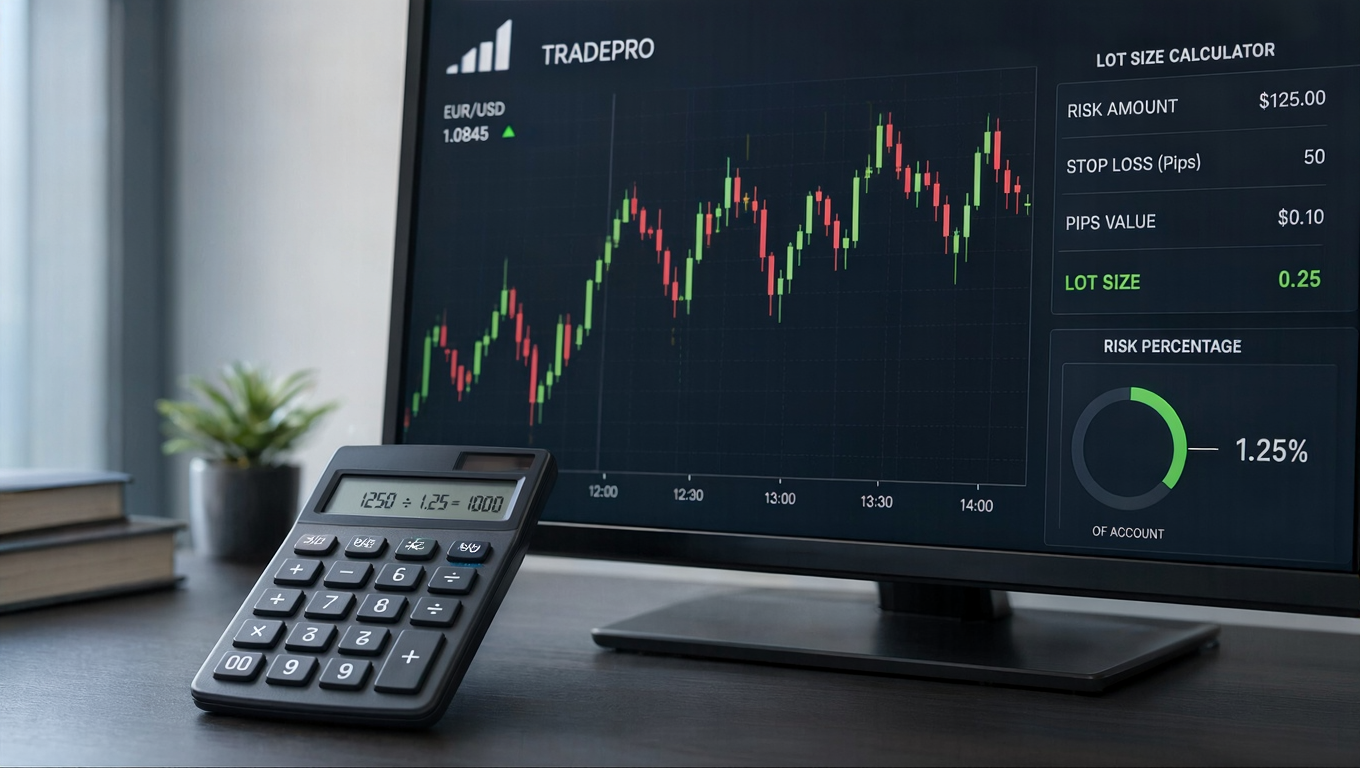
The core formula for calculating position size is straightforward: Position Size = (Account Balance × Risk Percentage) / (Stop Loss in Pips × Pip Value). Let us walk through a concrete example. You have a $10,000 account and follow the 1% risk rule, so your maximum loss per trade is $100. Your stop loss is 20 pips wide on EUR/USD, where each pip is worth $10 per standard lot. The calculation is: $100 / (20 × $10) = $100 / $200 = 0.5 standard lots. This means you should trade exactly 0.50 lots for this setup. If your stop loss were wider — say 40 pips — the position size would be $100 / (40 × $10) = 0.25 lots. The wider your stop, the smaller your position size. This inverse relationship ensures that your dollar risk remains constant regardless of the trade setup, allowing you to scale position sizes naturally with different stop distances.
For accounts denominated in different currencies, or when trading pairs where the quote currency differs from your account currency, you need to convert the pip value. Most trading platforms include a built-in position size calculator that handles these conversions automatically. However, understanding the underlying math helps you verify the calculator's output and make quick adjustments during active trading. The key insight is that position sizing is a function of risk percentage — never of potential profit. Many beginners size their positions based on how much they hope to make rather than how much they are willing to lose, which leads to oversized positions and catastrophic losses when trades go wrong.
Using Position Size Calculators Effectively
Most trading platforms and many forex websites offer free position size calculators. These tools typically ask for your account currency, account balance, risk percentage, stop-loss distance in pips, and the pair you are trading. The calculator then outputs the exact lot size you should trade. Some calculators also show the pip value and the total dollar amount at risk for confirmation. When using a calculator, always double-check the pip value for the pair you are trading, especially for yen pairs or cross pairs where pip values differ from the standard $10 per lot on USD-quoted pairs. For USD/JPY quoted to two decimal places, one pip equals 0.01, and the pip value in USD depends on the current exchange rate. Getting the pip value right is essential for accurate position sizing.
Adjusting Position Size for Different Pair Types
- USD-quoted pairs (EUR/USD, GBP/USD, AUD/USD, NZD/USD) — quote currency is USD. One standard lot = $10 per pip. Simple and intuitive. Use this as your baseline for understanding pip values.
- USD-base pairs (USD/JPY, USD/CHF, USD/CAD) — base currency is USD, quote currency varies. Pip value in USD depends on the pair's exchange rate. For USD/JPY at 150.00, one pip (0.01) = 1,000 JPY ÷ 150.00 = approximately $6.67 per standard lot. Always calculate the pip value before sizing your position.
- Cross pairs (EUR/GBP, GBP/JPY, EUR/AUD) — neither currency is USD. Pip value in USD requires converting through the quote currency. Most Forex calculators handle this automatically, but you should understand that cross pairs have variable pip values that change with exchange rates.
- Mini and micro lots — 1 mini lot (10,000 units) = $1 per pip for USD-quoted pairs. 1 micro lot (1,000 units) = $0.10 per pip. Use mini and micro lots to precisely match your position size to your risk calculation when the standard lot calculation produces a fractional result.
Scaling Position Size as Your Account Grows
Your position sizes should grow naturally with your account. If you risk 1% per trade on a $10,000 account, your risk per trade is $100. When your account grows to $12,000, your risk per trade increases to $120, and your position sizes increase proportionally. This geometric scaling is the engine of compound growth. However, the reverse is also true: when your account declines, your risk per trade and position sizes must decrease automatically. Do not maintain the same lot size after a drawdown — reducing position sizes after losses is essential for protecting your remaining capital. A common practice is to recalculate your position size before every trade based on your current account balance, not your initial deposit or peak balance.
Common Position Sizing Mistakes
The most frequent mistake is ignoring position sizing entirely and trading the same lot size regardless of account balance or stop distance. Another common error is increasing position size after losses to try to recover faster — this is the Martingale approach and it is the fastest path to blowing up your account. Some traders also fail to account for correlation when trading multiple positions simultaneously — if you are risking 1% on EUR/USD and another 1% on GBP/USD, your total risk is closer to 2% because these pairs are highly correlated. Always reduce individual position sizes when trading correlated pairs to keep your total portfolio risk at your target level.
Conclusion
Position sizing is the most practical and impactful risk management tool you have. Master the basic formula — Account Balance × Risk % / (Stop Loss in Pips × Pip Value) — and use it before every trade. Use position size calculators to speed up the process but understand the underlying math so you can verify the results. Adjust your position sizes for different pair types and account for correlation when trading multiple positions. Always calculate position size based on your current account balance, not your peak or initial balance. Remember that position sizing is not about maximizing profit per trade — it is about surviving losing streaks so you can compound your capital over time. The trader who sizes positions correctly will outperform the trader with a better entry signal but no position sizing discipline, every single time.
A passionate writer and content creator.
Community Comments
Please log in to comment on this blog post.
Log InNo comments yet. Be the first to comment!