
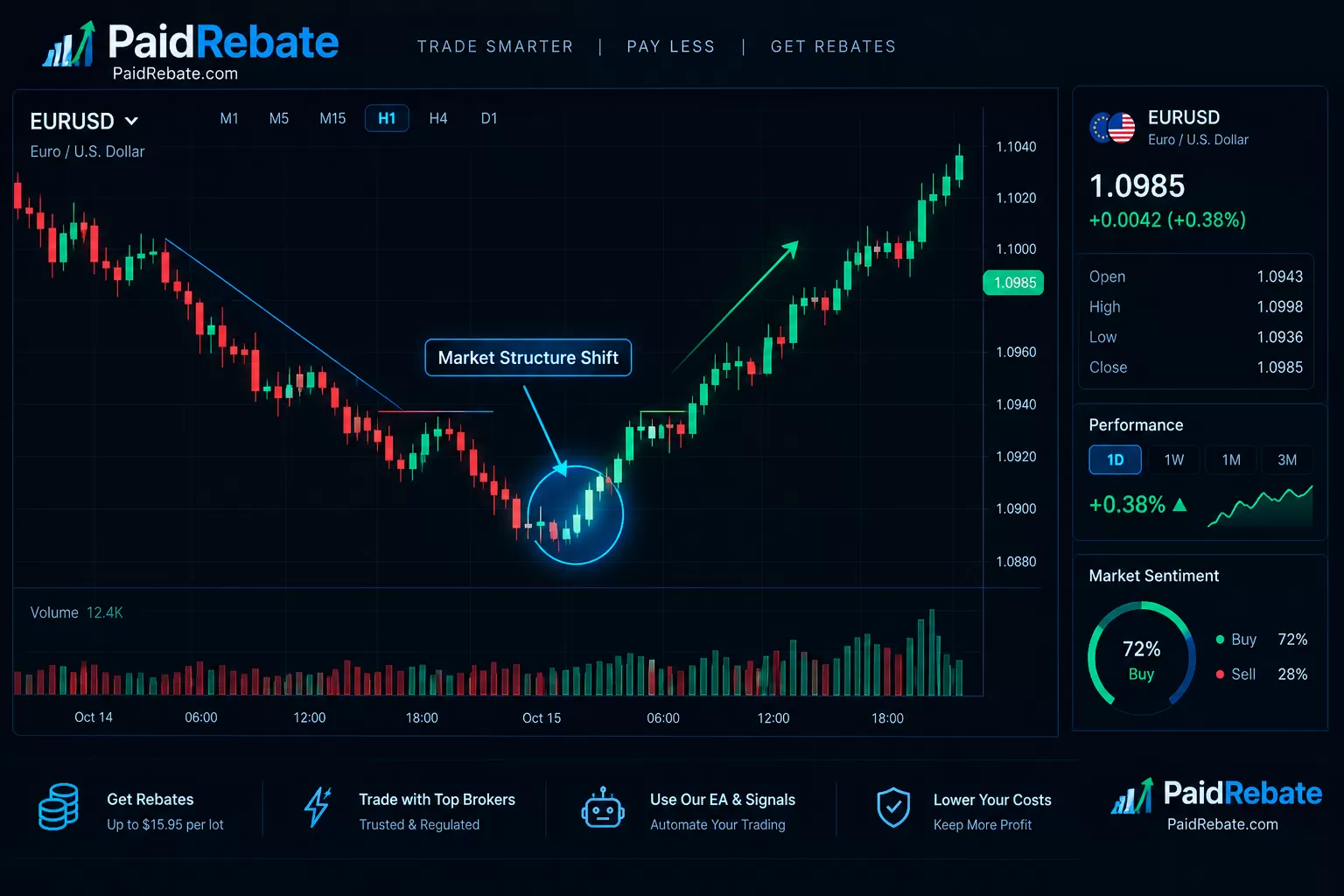
Market Structure Shift (MSS): How to Identify Institutional Reversals Early
One of the most dangerous pitfalls for retail traders is trying to time market tops and bottoms without the benefit of objective confirmation, entering reversal trades only to get stopped out multiple times as the trend continues.
In institutional price action and Smart Money Concepts, they refer to this situation as a Market Structure Shift.
1. What is a Market Structure Shift (MSS)
A Market Structure Shift is the first structural signal that an established market trend has lost steam and turned around
While a Break of Structure (BOS) is the confirmation that a trend is continuing, an MSS is when the bulls or bears have convincingly broken the key counter-trend swing level with strong momentum to flip the trend around.
A Bullish MSS is when price has been making a series of lower highs and lower lows in a downtrend and convincingly breaks above the recent lower high with bullish momentum. In an uptrend, a Bearish MSS is when the price has been making a series of higher highs and higher lows and convincingly breaks below the recent higher low with bearish momentum.
2. Anatomy of a Valid MSS: 3 key rules
Not every move above a swing low or below a swing high is a valid MSS. To separate real MSS's from fakeouts, we have to look at 3 rules that a valid MSS should satisfy.
Prior Liquidity Sweep: Before the shift in structure takes place, there should be a sweep of liquidity (stop orders) above a key swing low or below a key swing high. An institutional "liquidity raid" which gives the reversal legs to run with.
Displacement (Strong Candles): The move past the swing level should be a strong bullish or bearish candle. A wick poking its nose above or below a swing level is not a strong displacement.
Imbalance / Fair Value Gap (FVG): The aggressive displacement leg often leaves behind a Fair Value Gap or Order Block which marks the exact level where institutions have jumped in to take the opposite bias on the retest.
3. Step-by-Step MSS Trading Plan
To trade the MSS reversal setup, here's how you would go about it:
Set up directional bias: Identify key higher-timeframe (H4 or Daily) support/demand or resistance/supply levels
Wait for the Liquidity Sweep: Let the price sweep liquidity beyond the swing extreme into your higher-timeframe zone.
Confirm the MSS on the lower timeframes: Drop down to an execution timeframe (M15 or M5) and wait for a displacement candle to close beyond the recent opposing swing point.
Enter on Retracement: Put a limit order in at the Fair Value Gap (FVG) or Order Block created by the displacement leg.
Set Stop Loss & Take Profit: Your stop-loss goes just beyond the liquidity sweep extreme. Set take-profit levels at the opposing liquidity pools (equal highs or previous session extremes).
Conclusion
The Market Structure Shift is an invaluable technique for traders looking to stop second-guessing themselves about where in the trend the market will turn and start trading with institutional order flow. By demanding a prior sweep of liquidity and strong displacement before entering reversal trades, you can greatly reduce whipsaws and improve your risk-reward positioning on each trade.
A passionate writer and content creator.
Frequently Asked Questions
Account Management
Questions about managing your PaidRebate account.
Community Comments
Please log in to comment on this blog post.
Log InNo comments yet. Be the first to comment!