
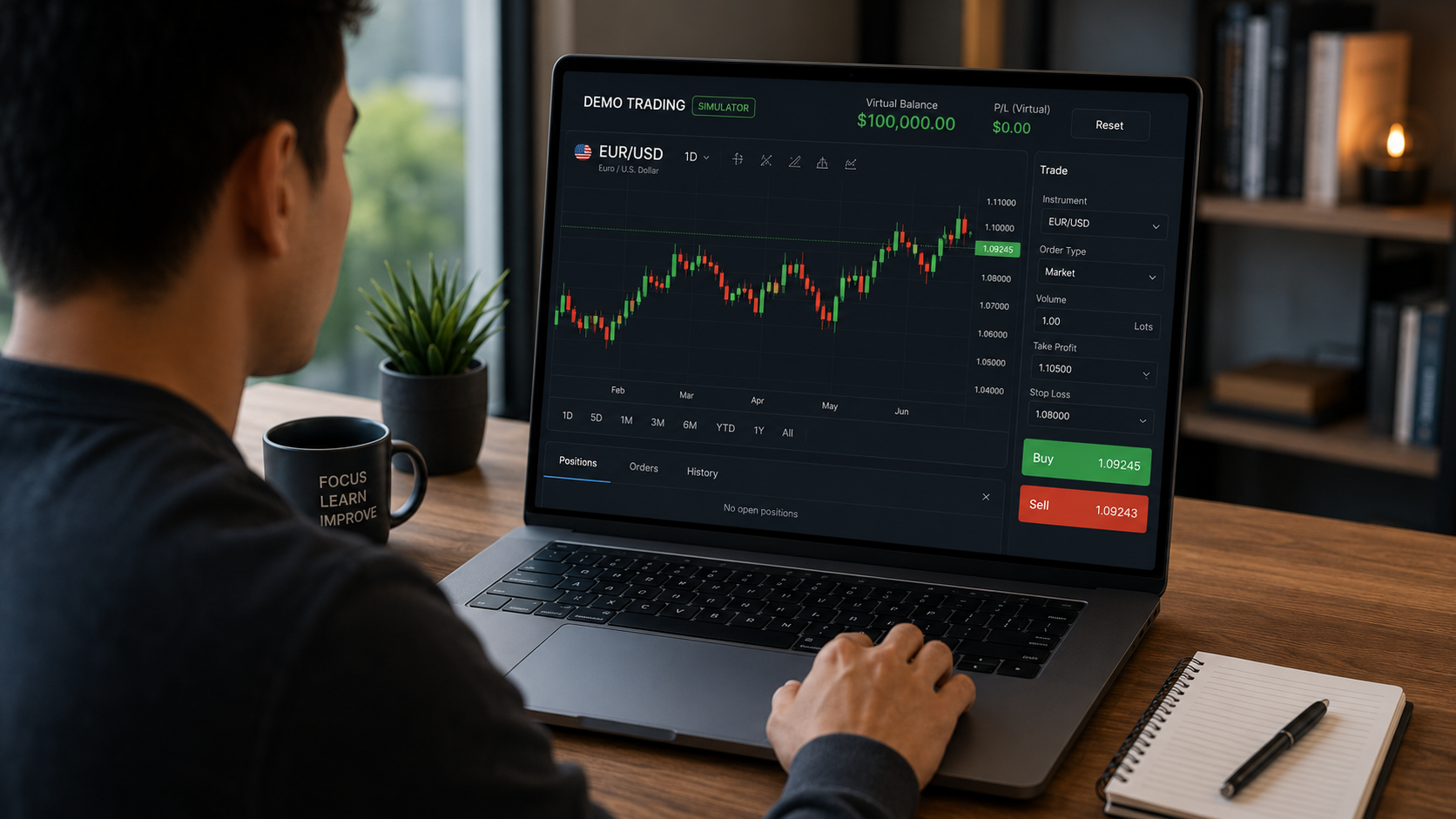
Why Demo Trading Matters
A demo account is a risk-free environment where you can practice trading with virtual money. Every professional trader spent months — sometimes years — on demo before trading live capital. The demo account replicates real market conditions, allowing you to execute trades, test strategies, and build confidence without putting your hard-earned money at risk. Think of it as your personal flight simulator — a place where mistakes cost nothing but provide invaluable lessons that will save you thousands of dollars later.
Most brokers offer demo accounts with virtual balances ranging from $10,000 to $100,000, giving you the freedom to experiment with different position sizes and trading styles. The key is to treat your demo account with the same seriousness as a live account. Many traders blow through demo capital recklessly because they know it is not real money, but this creates habits that will destroy a real account. Approach demo trading as a training ground where you develop the discipline, skills, and routines that will serve you for your entire trading career.
What to Practice on Demo
- Learn your trading platform inside and out — master every feature of MetaTrader 4 or 5, including order types, chart settings, indicators, templates, and automated trading tools. Know where every function is without having to search for it. Practice placing market orders, pending orders, and OCO (one-cancels-other) setups until they become second nature.
- Test new strategies without financial fear — use the demo to validate your trading ideas before risking real capital. Run a minimum of 50 to 100 trades per strategy to gather statistically significant data. Measure win rate, average risk-reward ratio, maximum drawdown, and profit factor to evaluate whether the strategy has positive expectancy.
- Understand how different market conditions affect your approach — trade through trending, ranging, and volatile market periods. Notice how your strategy performs during London and New York sessions compared to Asian session trading. Learn to identify when the market environment is unfavorable for your approach and when it is optimal.
- Build muscle memory for order placement and trade management — practice entering and exiting trades quickly and accurately. Set stop losses and take profit levels consistently. Learn to trail stops and adjust positions without hesitation. This muscle memory will be invaluable when you transition to live trading and every second counts.
- Develop your trading routine — create a pre-market checklist, a trade execution process, and a post-trade review system. Use the demo to establish habits like checking the economic calendar, analyzing higher timeframes first, and journaling every trade. A solid routine built on demo will carry over to live trading seamlessly.
When to Transition to Live
Move to a live account only after you achieve at least three consecutive months of profitability on demo while following all your trading rules. Profitability means not just a positive account balance, but consistent performance with controlled drawdowns. An account that fluctuates wildly between profits and losses is not ready for live funding. Start with a small deposit — as little as $100 to $500 — and continue using the demo account for any new strategies you want to test. Transition gradually: trade the smallest possible position sizes (micro lots) initially, and only increase size after you demonstrate consistent discipline with real money on the line.
Common Demo Pitfalls
Demo trading lacks psychological pressure — the single most important difference from live trading. Traders who are reckless on demo — taking oversized positions, ignoring stop losses, or revenge trading — often blow up real accounts when real money is at stake. Treat your demo like real money by using proper risk management and position sizing from day one. Another common pitfall is overestimating your readiness: three profitable demo months does not guarantee live success. The emotional weight of real money changes behavior dramatically. Be honest with yourself about your discipline level and give yourself more time on demo if you have any doubts.
Setting Goals for Your Demo Period
Create specific objectives for your demo journey. Month one: master the platform and learn to identify trends and key levels. Month two: develop and test one or two specific strategies with clear entry and exit rules. Month three: refine your risk management and practice following your trading plan without deviation. Track your progress against these milestones and only consider moving to live trading when you have achieved all three. Rushing the demo phase is the most common mistake beginners make — patience during practice pays exponential dividends in live trading.
Conclusion
Your demo account is the most valuable tool in your trading education. Use it strategically to learn your platform, test strategies, build discipline, and develop routines that will sustain you through the challenges of live trading. Avoid the temptation to rush into real money before you are ready — the demo phase is not a delay but an investment in your future success. Treat every demo trade as if real money were at stake, and you will develop the habits and mindset of a professional trader long before you risk a single dollar of your own capital.

A passionate writer and content creator.
Community Comments
Please log in to comment on this blog post.
Log InNo comments yet. Be the first to comment!