
How to Read and Use an Economic Calendar for Forex Trading

What Is an Economic Calendar?
An economic calendar lists upcoming economic data releases, central bank meetings, and other events that can move the forex market. It is one of the most important tools for any trader, regardless of whether you prefer technical or fundamental analysis. Even purely technical traders need to know when high-impact news is scheduled, because these events can cause unpredictable volatility that violates chart patterns and triggers stop losses. The economic calendar transforms uncertainty into awareness — while you cannot predict exactly how the market will react to a news release, knowing when events are scheduled allows you to prepare, reduce risk, and stay out of the market when conditions are dangerous.
Economic calendars are freely available from major financial websites like ForexFactory, Investing.com, DailyFX, and Bloomberg. Most brokers also include an economic calendar within their trading platforms. The best calendars allow you to filter by currency, impact level, and event type, and they update automatically as new data becomes available. A good habit is to check the calendar at the start of each trading day and note the high-impact events scheduled during your trading hours. This simple routine takes only a few minutes but can save you from catastrophic losses caused by unexpected volatility.
Understanding the Calendar
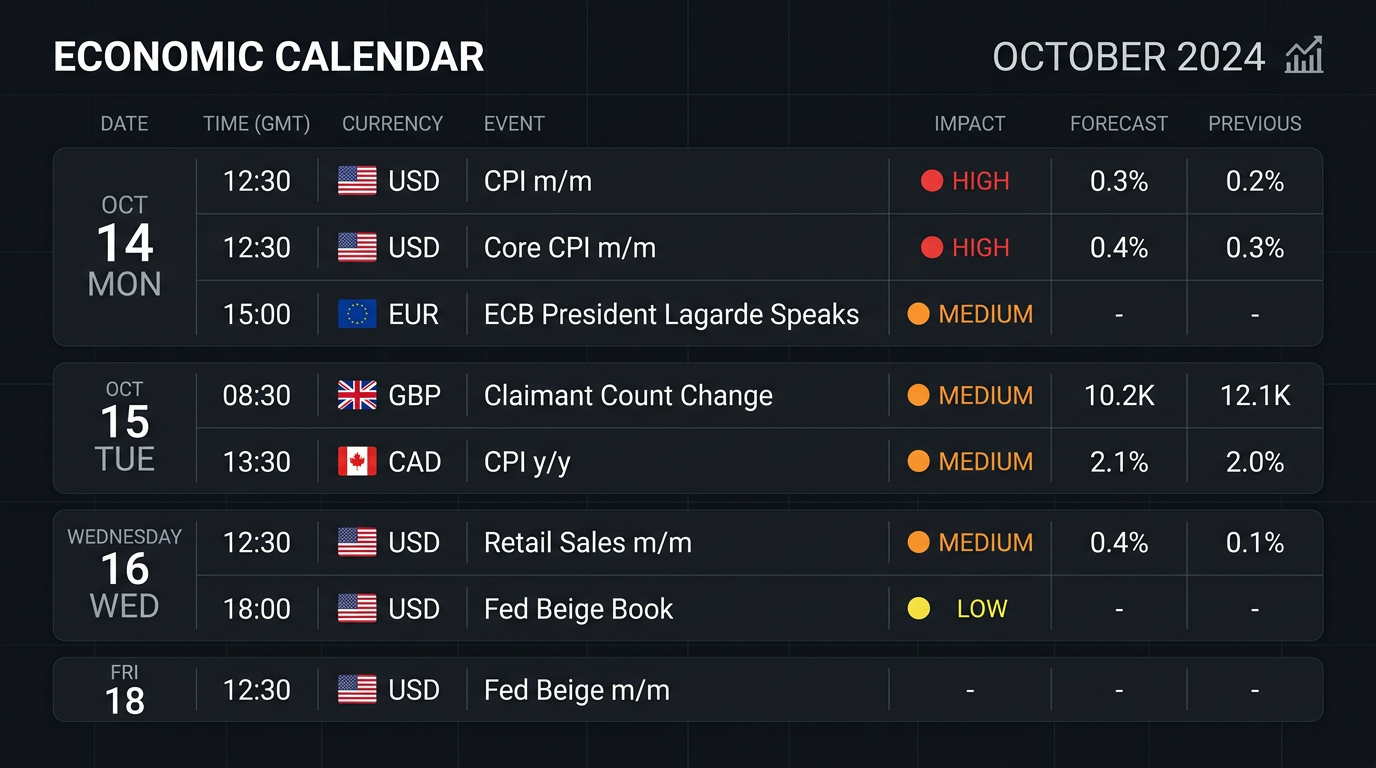
- Impact rating — red (high impact), orange (medium impact), yellow (low impact). Red events like Non-Farm Payrolls, FOMC rate decisions, and CPI releases consistently produce significant market movement. Orange events can move the market but the direction and magnitude are less certain. Yellow events typically cause minimal volatility and can usually be ignored.
- Previous value — the last reported number for this indicator. This provides context for the new release. If Non-Farm Payrolls was previously 250,000 and the forecast is 200,000, the market expects a slowdown in job creation.
- Forecast — what economists and analysts expect the actual number to be. The forecast is the market's consensus expectation. Surprises relative to the forecast drive market volatility — a large deviation from the forecast produces the biggest moves.
- Actual — the released number. Comparison to the forecast determines market reaction. If actual > forecast, the currency typically strengthens (positive surprise). If actual < forecast, the currency weakens (negative surprise). However, the reaction also depends on whether the data confirms or contradicts the current market narrative.
- Revised — many indicators are revised after initial release. Revisions can be as market-moving as the initial release, especially if they significantly change the picture of the economy. Always check whether a previous value has been revised up or down.
How to Use the Calendar to Reduce Risk
Check the economic calendar daily before your trading session begins. Mark high-impact events that fall within your trading hours and note the exact release time. The safest course of action around a major release is to be completely flat — no open positions — for the duration of the event and shortly afterwards. The volatility spike can trigger stop losses well beyond normal levels and cause slippage that dramatically increases your actual loss, and a stop loss is not guaranteed to fill at your chosen price in those conditions. Avoid entering new trades in the run-up to red-news events, as spreads widen significantly and price action becomes erratic. If you already hold positions going into a release, closing them beforehand is the most reliable way to limit the damage. Most retail accounts should treat major releases as a reason to sit out rather than a trading opportunity.
Key Economic Indicators to Watch
Non-Farm Payrolls (NFP) is the single most important US economic release, reported on the first Friday of each month. It measures employment changes and drives massive volatility in USD pairs. CPI (Consumer Price Index) measures inflation and directly influences central bank interest rate decisions — above-forecast CPI typically strengthens the currency as it raises rate hike expectations. GDP (Gross Domestic Product) is the broadest measure of economic health — strong GDP supports currency strength. Central bank interest rate decisions are among the most anticipated events, with the accompanying press conferences often moving markets more than the rate decision itself. Retail sales, PMI (Purchasing Managers' Index), industrial production, and consumer confidence are also important, though their impact varies by market conditions. Learn how each indicator affects currency values and practice observing market reactions to build your understanding of fundamental analysis.
Common Calendar Mistakes
One of the biggest mistakes traders make is trading during news events at all. The volatility spikes, spreads widen to 5-10 times normal levels, and slippage means your stop loss may be filled far from the price you expected — or not filled at all. Another common error is assuming the market will react logically to data — sometimes bad news strengthens a currency because the market had priced in even worse numbers. The actual reaction depends on expectations, positioning, and the broader market narrative, not just the data itself. Finally, do not ignore medium-impact events — some of the biggest market moves occur on what appear to be minor releases, especially when the data contradicts the prevailing market sentiment.
Conclusion
The economic calendar is an indispensable tool that every forex trader should use daily. It provides essential advance notice of market-moving events, allowing you to prepare, reduce risk, and avoid being caught off guard by sudden volatility. Master the basics of reading the calendar — understanding impact ratings, comparing actual values to forecasts, and identifying which releases to avoid. Build the habit of checking the calendar every morning and use it to decide when to stay flat. The economic calendar does not tell you which way the market will move, but it tells you when to be careful — and that knowledge is invaluable for protecting your capital.
A passionate writer and content creator.
Community Comments
Please log in to comment on this blog post.
Log InNo comments yet. Be the first to comment!