
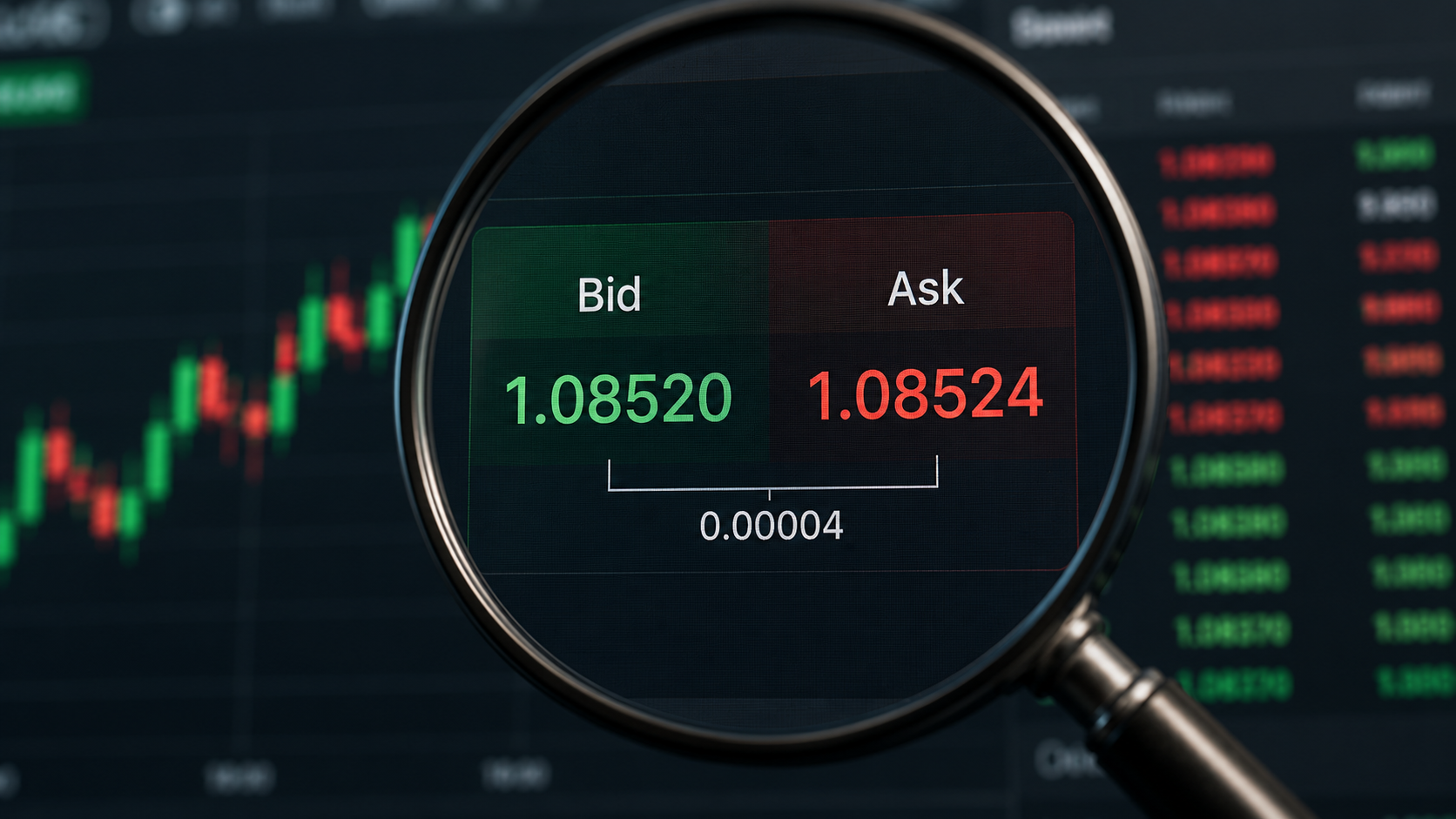
Anatomy of a Forex Quote
A currency quote shows the exchange rate between two currencies. EUR/USD at 1.1050 means it costs 1.1050 US dollars to buy one euro. The first currency is the base, the second is the quote currency. Understanding how to read a currency quote is the most fundamental skill in forex trading — every trade, every analysis, and every profit calculation depends on correctly interpreting these numbers. Despite its apparent simplicity, many beginners confuse bid and ask prices, miscalculate pip values, or fail to account for spreads in their trading decisions.
Currency pairs are divided into three main categories. Major pairs involve the US dollar paired with another major currency — EUR/USD, GBP/USD, USD/JPY, USD/CHF, AUD/USD, NZD/USD, and USD/CAD. These pairs offer the tightest spreads and highest liquidity. Cross pairs do not include the US dollar, such as EUR/GBP, GBP/JPY, and EUR/AUD — they have wider spreads but offer unique trading opportunities. Exotic pairs pair a major currency with the currency of an emerging economy, such as USD/TRY or EUR/TRY — these have the widest spreads and are best left to experienced traders due to their unpredictable behavior and high trading costs.
The Base and Quote Currency
Every currency pair has two components. The base currency is the first currency listed — it represents how much of the quote currency is needed to buy one unit of the base. When you buy EUR/USD, you are buying euros and simultaneously selling US dollars. When you sell EUR/USD, you are selling euros and buying US dollars. This is a crucial distinction: you always buy the base currency and sell the quote currency when going long, and vice versa when going short. Understanding this relationship helps you interpret price movements correctly. If EUR/USD rises from 1.1050 to 1.1100, the euro has strengthened against the dollar — it now costs more dollars to buy one euro.
Bid vs Ask Price
- Bid price — the price at which you sell the base currency (what the market will pay you). Listed on the left side of the quote
- Ask price — the price at which you buy the base currency (what you pay the market). Listed on the right side of the quote
- Spread — the difference between bid and ask, which is your cost to trade. A quote of 1.1050/1.1053 means a 3-pip spread, and you lose 3 pips immediately when you enter a trade
- Bid-ask behavior — the bid is always lower than the ask. When you see a quote, the price at which you can sell is always slightly worse than the price at which you can buy — that is how brokers and liquidity providers make money
Understanding Pips
A pip (percentage in point) is the smallest price movement in most currency pairs. For most pairs quoted to four decimal places, one pip equals 0.0001. If EUR/USD moves from 1.1050 to 1.1051, it has moved one pip. For yen pairs quoted to two decimal places (USD/JPY at 150.25), one pip equals 0.01. Some brokers now offer fractional pip pricing with a fifth decimal place — called pipettes — which allow for tighter spreads but do not change the fundamental pip calculation. Knowing pip values is essential for calculating risk and potential profit. For a standard lot (100,000 units) on EUR/USD, one pip is worth $10. For a mini lot (10,000 units), one pip equals $1. For a micro lot (1,000 units), one pip equals $0.10.
Calculating Pip Value
Pip values vary depending on the pair and your account currency. For pairs where the quote currency matches your account currency (USD account trading EUR/USD), the calculation is straightforward: one standard lot = $10 per pip. For pairs where the quote currency differs, you must convert the pip value to your account currency. Most trading platforms display pip values automatically in the position size calculator, but understanding the underlying math helps you verify calculations and plan trades manually when needed. A practical shortcut: for USD-based accounts, one standard lot of any USD-quoted pair is approximately $10 per pip, and one standard lot of any yen pair is approximately $9 to $11 per pip depending on the current exchange rate.
Reading Different Pair Types
Major pairs (involving USD) have the tightest spreads, often 0.5 to 1.5 pips during peak liquidity hours. Cross pairs (no USD) typically have spreads of 1.5 to 4 pips, depending on the pair and market conditions. Exotic pairs have the widest spreads, sometimes 5 to 20 pips or more, making them expensive to trade. Choose your pairs based on your strategy and budget. Scalpers and day traders should focus on major pairs for the lowest costs. Swing traders can explore cross pairs for additional opportunities. Beginners should start with EUR/USD and GBP/USD, as their tight spreads and predictable behavior make them the most forgiving pairs for learning.
Conclusion
Reading forex quotes correctly is the foundation of all currency trading. Master the distinction between base and quote currencies, understand why bid and ask prices differ, learn to calculate pip values quickly, and choose currency pairs that match your trading style and budget. Practice reading quotes on your demo platform until the numbers become intuitive — you should be able to glance at any quote and immediately know the spread, the direction of the market, and the pip value for your preferred position size. This knowledge will serve you in every trade you take for the rest of your trading career.

A passionate writer and content creator.
Community Comments
Please log in to comment on this blog post.
Log InNo comments yet. Be the first to comment!