
How to Keep a Trading Journal That Improves Your Results

Why Every Trader Needs a Trading Journal
A trading journal is far more than a simple record of wins and losses. It is your personal laboratory for continuous improvement — the single most powerful tool you have for identifying patterns in your behavior, refining your strategy, and accelerating your learning curve. Professional traders treat journaling as a non-negotiable part of their daily routine, and for good reason: you cannot improve what you do not measure. A trading journal transforms vague feelings about your performance into hard data that reveals exactly what you are doing right and what you need to change. Without a journal, you are flying blind, repeating the same mistakes month after month without realizing it.
The psychological benefits of journaling are equally important. Writing down your thoughts and emotions before, during, and after each trade forces you to slow down and think rationally. It creates a buffer between impulse and action, reducing the likelihood of emotional trading decisions. When you review your journal, you see your own patterns with brutal clarity — the revenge trade after a loss, the fear that made you exit a winner too early, the greed that kept you in a losing position too long. These insights are impossible to gain from simply looking at your account balance. A trading journal is your mirror, reflecting back the habits and behaviors that determine your success or failure in the markets.
What to Record in Every Trade
- Date and time of entry and exit — note which market session was active and whether any major news events were scheduled. This helps you identify which trading conditions suit your strategy best and which sessions produce your most profitable trades.
- Pair and direction (buy or sell) — basic but essential. Over time, this data reveals which currency pairs you trade most profitably and whether you have a bias toward long or short trades.
- Entry and exit prices — record the exact prices for both entry and exit. Calculate the actual pip gain or loss, including spread costs. This data feeds directly into your performance statistics.
- Stop loss and take profit levels — note where you placed your stop and target, and whether the trade hit either level or was manually closed. This helps you evaluate whether your stop and target placement is appropriate for your strategy.
- Reason for entry — describe in detail which setup or signal triggered the trade. Be specific: "Price bounced off the 200 EMA on the 4-hour chart with a bullish engulfing candle at a previous resistance-turned-support level." Vague entries produce vague results.
- Emotional state — rate your confidence level before entering (1-10). Note any emotions present: fear, greed, impatience, boredom, overconfidence. This is often the most revealing data in the entire journal, as it helps you identify which emotional states lead to your worst trades.
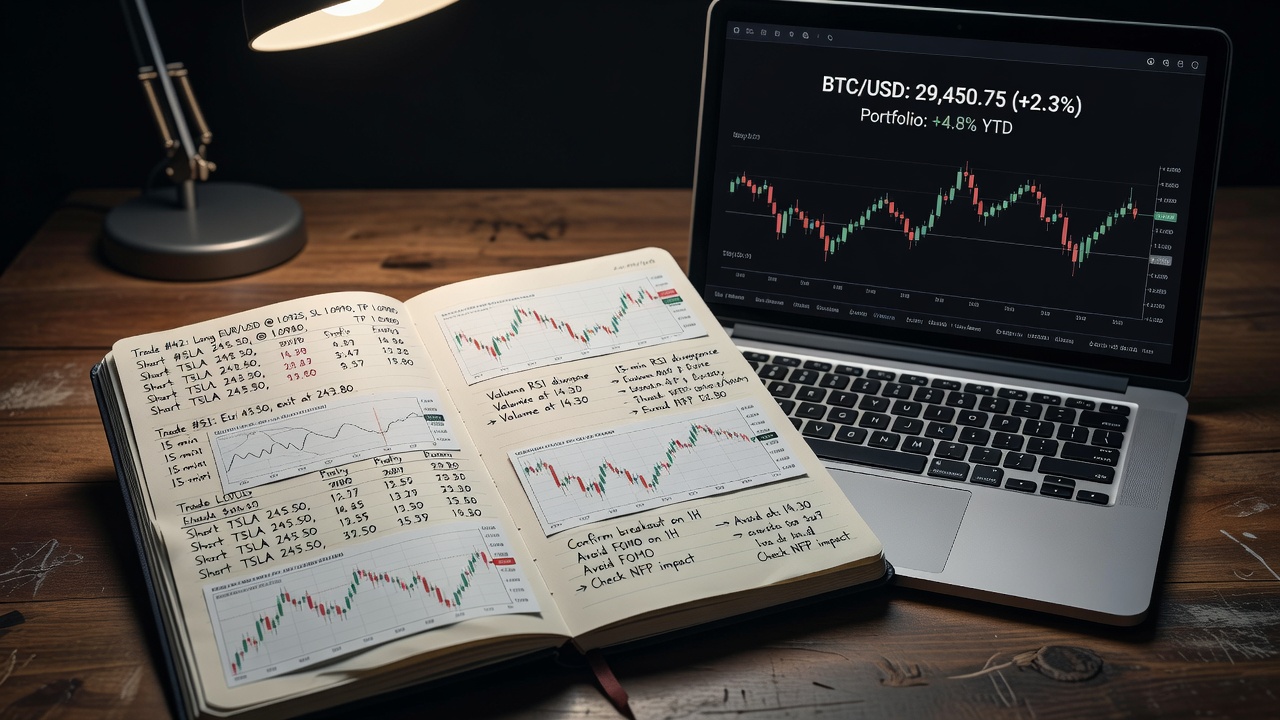
- Chart screenshot — a visual snapshot of your entry point with annotations shows the exact market conditions at the time of the trade. These screenshots become invaluable reference material when reviewing and refining your strategy.
- Post-trade review — after the trade closes, note whether you followed your plan perfectly, what you learned, and what you would do differently. This transforms every trade into a learning opportunity regardless of whether it was a winner or loser.
How to Review Your Journal Effectively
Collecting data without analysis is just hoarding. Set aside dedicated time for journal review at regular intervals. Weekly reviews should focus on identifying immediate patterns: Did you break any rules this week? Were there emotional patterns on certain days? Did you trade a particular pair poorly? Monthly reviews should calculate key performance metrics: win rate, average risk-reward ratio, profit factor, maximum drawdown, and most importantly, plan adherence percentage. Quarterly reviews should look at the bigger picture: Which strategies are working best under which market conditions? Are you improving over time? Are there persistent weaknesses that need targeted work? A structured review process ensures that you extract maximum learning from every trade you take.
Key Metrics to Track
Beyond basic win rate, focus on metrics that actually measure your effectiveness as a trader. Your profit factor — gross profits divided by gross losses — tells you whether your strategy is fundamentally sound. A profit factor above 1.5 is good; above 2.0 is excellent. Your average risk-reward ratio measures the relationship between your winners and losers. A ratio of 1:2 means your average winner is twice the size of your average loser. Your maximum drawdown reveals the worst losing streak you have endured and helps you set appropriate position sizes. Your plan adherence percentage — the percentage of trades where you followed every rule perfectly — is perhaps the most important metric of all. A high adherence rate combined with positive expectancy means your system works and you are executing it properly.
Digital vs Paper Journals
Each format has distinct advantages. Spreadsheets like Google Sheets or Excel are excellent for calculations and data analysis — you can build formulas to automatically calculate your key metrics and generate charts that visualize your progress. Dedicated journaling apps like Tradervue, Edgewonk, or TradingDiary Pro offer built-in analytics, trade importing, and chart annotation features that save time and provide professional-grade performance reports. Paper journals offer a different benefit — the physical act of writing slows down your thinking and promotes deeper reflection. Many successful traders use a hybrid approach: a paper journal for emotional reflection and quick notes during the trading day, combined with a spreadsheet or app for detailed performance analysis. The best format is the one you will actually use consistently. Start simple and add complexity as journaling becomes a habit.
Common Journaling Mistakes to Avoid
The biggest mistake is not journaling at all — many traders skip this step because it feels tedious or time-consuming. But the few minutes per trade you invest in journaling pay back exponentially in improved performance. Another common error is being dishonest in your journal — writing what you think you should have done rather than what you actually did. Your journal is for your eyes only; brutal honesty is essential for real improvement. Do not record only losing trades or only winning trades — every trade contains valuable data. Finally, avoid over-engineering your journal with too many fields that make the process overwhelming. Start with five essential fields — date, pair, entry reason, emotional state, and P&L — and gradually add more as journaling becomes a natural part of your routine.
Conclusion
A trading journal is the most valuable learning tool at your disposal. It provides the data you need to identify patterns in your behavior, measure your performance objectively, and accelerate your journey to consistent profitability. Record every trade with details on entry, exit, strategy, emotional state, and lessons learned. Review your journal regularly — weekly for patterns, monthly for metrics, quarterly for strategic direction. Choose a format — digital, paper, or hybrid — that you will maintain consistently. Be brutally honest in your entries, and treat every trade, whether winning or losing, as a source of valuable data. The trader who journals diligently will improve twice as fast as the trader who does not, because they have the data they need to learn from every single trade they take.
A passionate writer and content creator.
Community Comments
Please log in to comment on this blog post.
Log InNo comments yet. Be the first to comment!