
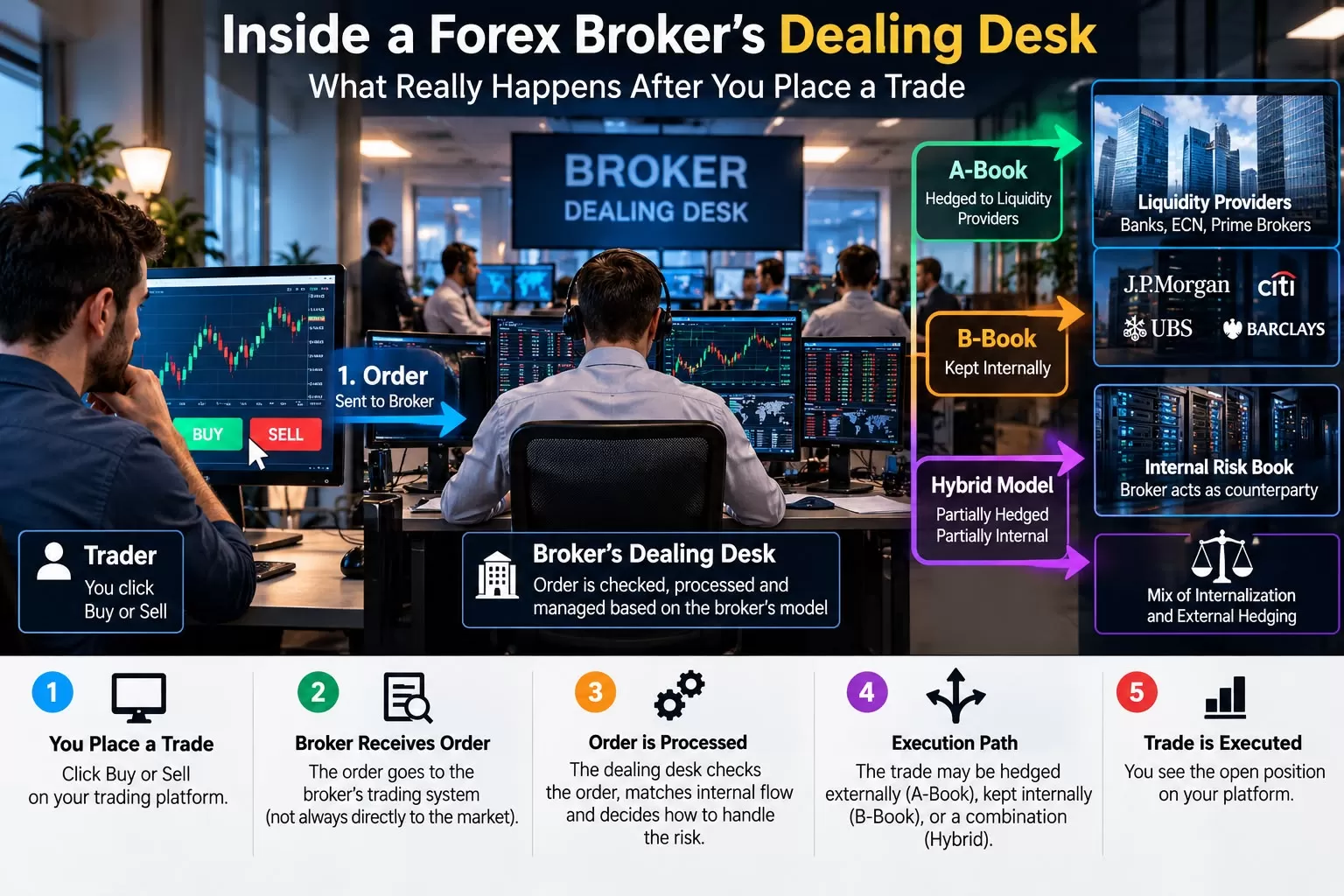
Inside a Forex Broker’s Dealing Desk: What Really Happens After You Place a Trade

Inside a Forex Broker’s Dealing Desk: What Really Happens After You Place a Trade
A-Book, B-Book, Hybrid Execution & What Traders Should Know
When a trader clicks Buy or Sell on a forex platform, everything looks simple.
You see a price, place an order, and within milliseconds your position appears on the screen.
But behind that simple interface, a much more complex process may be taking place.
Many retail traders assume that every order is automatically sent to a bank, liquidity provider, or the wider forex market. Depending on the broker and its execution model, that may not always be the case.
A broker may:
- Hedge the trade externally
- Keep the exposure internally
- Offset it against another customer's position
- Use a combination of these methods
Understanding this process can help traders better understand how dealing desks work, how brokers manage risk, and where potential conflicts of interest can arise.
Your Forex Trade May Never Reach an Exchange
Retail spot forex is largely an over-the-counter (OTC) market.
Unlike buying a stock on a centralized exchange, a retail forex transaction may be executed directly between the customer and the dealer.
In an OTC retail forex structure, the dealer can be the customer's counterparty. If the customer buys, the dealer may be on the other side of that transaction; if the customer sells, the dealer may take the opposite side.
That does not automatically mean anything improper is happening.
It simply means the structure can be different from what many traders imagine when they hear terms such as:
- Market Execution
- Direct Market Access
- Interbank Market
- Liquidity Provider
The important question is therefore not simply:
"Did my broker accept my order?"
A more important question is:
"What did the broker do with the risk after accepting my order?"
A-Book, B-Book and Hybrid Models
The terms A-Book and B-Book are widely used within the trading industry, although they are not universal regulatory classifications.
In simple terms, they describe how a broker may manage customer exposure.
What Is an A-Book Model?
In an A-Book-style arrangement, the broker generally passes or hedges customer market exposure with an external liquidity provider or another counterparty.
Example
Imagine a trader buys EUR/USD.
The broker may establish an offsetting position externally. This can reduce the broker's direct exposure to the trader's profit or loss.
In this type of model, the broker may generate revenue primarily through:
- Spread markup
- Commission
- Financing charges
- Other disclosed trading fees
The broker remains involved in the execution process, but its objective is generally to transfer or reduce the market risk created by the customer's position.
What Is a B-Book Model?
With an internalized or B-Book-style model, the broker may decide not to hedge every customer position externally.
Instead, some or all of the exposure can remain within the broker's own risk book.
Simple Example
Suppose a trader buys 1 lot of EUR/USD.
If the broker does not externally hedge that position, the broker retains exposure to the opposite side.
If the trader loses $500, the broker's internal exposure may benefit by a corresponding amount before other costs and offsets are considered.
If the trader makes $500, the broker may need to absorb that exposure through its internal book unless it has been offset elsewhere.
Again, B-Book does not automatically mean scam or misconduct.
Internalization can be a legitimate risk-management model.
The important issue is how the broker manages the resulting conflict of interest.
The Model Many Traders Never Hear About: Hybrid Execution
Real-world broker operations are often more complicated than simply choosing between A-Book and B-Book.
Many brokers can use a hybrid risk-management model.
Under a hybrid approach:
- Some exposure may be hedged externally.
- Some exposure may remain internal.
- The approach can change depending on market and risk conditions.
A broker's decisions may depend on factors such as:
- Total market exposure
- Currency pair
- Position size
- Current liquidity
- Market volatility
- Existing opposite customer positions
- Risk limits
- Client trading characteristics
- Concentration of exposure
For example, if a broker has many customers buying EUR/USD and other customers selling EUR/USD, some of those positions may naturally offset one another.
Instead of externally hedging every individual order, the broker may focus on its remaining net exposure.
This can potentially reduce transaction and liquidity-provider costs.
What Does a Dealing Desk Actually Do?
Many traders imagine a dealing desk as a group of people manually deciding whether individual traders should win or lose.
Modern dealing desks are generally much more sophisticated.
A significant part of risk management can be automated.
A broker may continuously monitor:
- Net EUR/USD exposure
- Net gold exposure
- Net GBP/USD exposure
- Client concentration
- Long vs. short imbalance
- Real-time P/L
- Margin utilization
- Liquidity conditions
- Market volatility
- External hedge positions
Example
Imagine a broker has:
1,000 clients buying EUR/USD
while
800 clients are selling EUR/USD.
Some of those positions naturally offset each other.
The broker may therefore focus on managing the remaining net exposure rather than sending every single customer order to an external liquidity provider.
From a risk-management perspective, this can make economic sense.
However, it also means that the relationship between the trader and broker can be more complicated than what appears on the trading terminal.
Are Losing Traders Treated Differently From Profitable Traders?
This is one of the most debated topics in retail forex.
A broker using a hybrid risk-management model may use different rules for different types of exposure.
For example, a risk system could determine that:
- Some exposure can remain internal.
- Other exposure should be hedged immediately.
A consistently profitable trader, high-volume scalper, arbitrage strategy, or trader creating concentrated exposure may represent a different risk profile from an occasional small-volume trader.
However, this does not mean every broker automatically places profitable traders on an A-Book and losing traders on a B-Book.
There is no basis for applying that claim to the entire industry.
The important point is that brokers can make sophisticated decisions about which exposures they hedge and which they retain.
Therefore, the execution model advertised on a broker's homepage may not reveal every detail about how aggregate risk is managed internally.
Why Would a Broker Keep Client Trades Internally?
There are several possible economic and operational reasons.
1. Natural Matching
One client buys EUR/USD while another client sells EUR/USD.
The broker can potentially offset much of the exposure internally.
2. Hedging Costs
Sending every small retail trade to an external liquidity provider can create transaction and infrastructure costs.
3. Risk Diversification
A broker may have thousands of positions across currencies and other assets. Some exposures may naturally offset each other.
4. Statistical Risk Management
Instead of treating every transaction as an isolated position, the broker can manage the overall book.
5. External Liquidity Conditions
During highly volatile periods, external liquidity can become thinner and potentially more expensive.
None of these factors by itself indicates misconduct.
The concern begins when an economic conflict affects how customers are treated.
The Conflict of Interest Traders Should Understand
If a broker keeps significant customer exposure internally, a potential conflict can exist.
The trader wants the position to make money.
The broker may have financial exposure in the opposite direction.
Regulators have recognized that conflicts of interest can exist in certain leveraged trading business models.
This does not automatically prove that a broker is manipulating trades.
There is an important difference between:
A conflict of interest existing
and
that conflict being abused.
A properly regulated broker is expected to have policies, procedures and controls designed to manage such conflicts.
For traders, however, understanding that the potential conflict exists is important.
Does a Dealing Desk Mean the Broker Manipulates Prices?
No.
That conclusion would be too simplistic.
A dealing desk or market-making model does not by itself prove:
- Price manipulation
- Stop hunting
- Unfair execution
- Deliberate trade interference
There are legitimate market makers throughout global financial markets.
What matters is how orders are actually executed.
Potential issues worth examining can include:
- Persistent asymmetric slippage
- Unexplained execution delays
- Unusual order rejections
- Requotes during normal market conditions
- Prices materially different from comparable market feeds
- Sudden changes in execution after a trader becomes profitable
- Unexplained trade cancellations
- Withdrawal restrictions connected to legitimate profitable trading
- Excessive retrospective price adjustments
One isolated incident may have a legitimate explanation.
Repeated patterns deserve closer investigation.
What About Slippage?
Slippage itself is normal.
Markets move continuously.
If a trader submits a market order while prices are changing rapidly, the final execution price may differ from the price visible when the order was submitted.
The more useful question is whether the broker's slippage appears reasonably balanced over time.
For example, traders may want to examine whether:
- Negative slippage happens frequently.
- Positive price improvement rarely occurs.
- Execution quality changes significantly during certain market conditions.
Professional traders often look beyond the advertised spread and examine actual execution quality.
The Broker Controls More of the Trading Environment Than Many Traders Realize
With OTC retail forex, the trading platform is not necessarily a direct window into a centralized exchange.
The trader sees:
Bid → Ask → Chart → Order → Execution
Behind that interface can be a much larger infrastructure:
Price Feeds → Aggregation → Markups → Execution Rules → Risk Engine → Internalization → Liquidity Providers → Hedging Algorithms
The front end may look simple.
The infrastructure behind it can be much more complex.
Does “STP” Mean Your Trade Is Automatically Sent to the Market?
Not necessarily.
Broker marketing may use terms such as:
- STP
- ECN
- NDD
- Market Execution
- Direct Market Access
However, traders should read the broker's actual legal and execution documents rather than relying only on marketing terminology.
What matters is the broker's contractual and execution structure, not simply the label displayed on its website or account page.
Can a Broker See Your Stop Loss?
If a stop-loss order is held on the broker's server, the broker's systems generally need information about that order in order to execute it.
That fact alone is not evidence of stop hunting.
A broker naturally needs access to customer orders and exposure for execution and risk management.
The stronger question is whether there is evidence that the broker deliberately manipulated execution or pricing to trigger orders unfairly.
That requires evidence.
A single chart from one price feed is often not enough because OTC forex prices can differ between brokers and liquidity providers.
A serious investigation may need to compare:
- Tick-level prices
- Multiple independent price feeds
- Spread at the time
- Execution timestamp
- Market volatility
- Liquidity conditions
- Broker trade logs
Without this information, accusing a broker of intentionally hunting stops can be premature.
Why Regulation Matters
A regulated dealing-desk broker is not automatically safer in every situation.
However, regulation can create important obligations involving:
- Capital
- Reporting
- Client disclosures
- Order handling
- Conflicts of interest
- Recordkeeping
- Complaints
- Financial promotions
The regulatory environment also differs between jurisdictions.
For this reason, traders should identify the specific legal entity holding their account and determine which regulator supervises that entity.
Questions Traders Should Ask Their Broker
Instead of simply asking whether a broker is "ECN" or "STP," traders can ask more specific questions:
About Execution
Are you the legal counterparty to my trades?
Do you internalize any client order flow?
Do you hedge client exposure externally?
Who are your liquidity providers or execution counterparties?
Where can I read your order execution policy?
About Slippage
How do you handle positive and negative slippage?
Can trades be repriced after execution? Under what circumstances?
About Regulation
Which legal entity holds my account?
Which regulator supervises that entity?
The quality and transparency of these answers can tell traders more than the label printed next to an account type.
The Truth Is More Complicated Than “A-Book Good, B-Book Bad”
One of the biggest misconceptions in retail trading is:
A-Book = Good Broker
B-Book = Bad Broker
Reality is more complicated.
An A-Book broker can still provide poor execution.
A market-making broker can still provide fair prices and reliable withdrawals.
A broker can also combine different execution and risk-management models.
Instead of focusing only on the A-Book or B-Book label, traders should consider whether the broker:
- Executes orders fairly
- Clearly discloses its role
- Manages conflicts properly
- Honors legitimate profits
- Processes withdrawals reliably
- Provides transparent trading conditions
- Operates under credible regulatory oversight
The execution label alone cannot answer all of these questions.
Final Thoughts
The retail forex industry can look very different from the trader's side of the screen compared with what happens inside a brokerage.
A trader sees an order.
The broker sees exposure.
A trader sees a stop loss.
The broker's risk system sees potential future liability.
A trader sees a one-lot EUR/USD trade.
The broker may see that trade as one small part of a much larger aggregated exposure.
That does not mean a broker is necessarily trading unfairly against its customers.
But it does mean traders should understand:
Who is on the other side of their transaction?
How does the broker manage its exposure?
How does the broker make money?
What legal entity holds the account?
Which regulator supervises that entity?
The phrase "we connect traders to the market" may sound simple.
The actual mechanics behind retail forex execution often are not.
For serious traders, understanding these mechanics can be just as important as understanding spreads, leverage and technical analysis.
PaidRebate will continue examining broker execution models, dealing-desk practices, regulation and trading conditions to help traders better understand what happens behind their trading platforms.
Disclaimer
This article is for educational and informational purposes only. Execution structures can differ between brokers, legal entities and jurisdictions.
The use of a dealing desk, internalization or market-making model does not by itself indicate improper conduct.
Traders should review the relevant broker's legal documents, execution policy and regulatory status before drawing conclusions.
A passionate writer and content creator.
Community Comments
Please log in to comment on this blog post.
Log InNo comments yet. Be the first to comment!