
How Central Banks Influence Forex Markets: The Complete Guide

Central Banks: The Most Powerful Players in Forex
Central banks are the most influential forces in the forex market. Their decisions on interest rates, monetary policy, and currency intervention directly determine the value of the currencies you trade. When a central bank speaks, the entire forex market listens — and moves. Understanding how central banks operate, what drives their decisions, and how to trade around their announcements is essential knowledge for any serious forex trader. Central banks set the fundamental backdrop against which all technical analysis and trading strategies play out. Ignoring them is like sailing without checking the weather forecast — you may have beautiful charts, but a storm can sink you in minutes.
Central banks have two primary mandates that vary by institution: price stability (controlling inflation) and maximum employment (supporting economic growth). For the Federal Reserve, these are codified as the "dual mandate." The European Central Bank's primary focus is price stability, while the Bank of England and Reserve Bank of Australia also target inflation within specific ranges. Every policy decision a central bank makes — whether to raise, hold, or cut interest rates, whether to implement quantitative easing or tightening — is ultimately aimed at achieving these mandates. When you understand what a central bank is trying to accomplish and how they interpret current economic conditions, you can anticipate their next moves and position yourself ahead of the market.
Key Central Bank Policy Tools
- Interest rates — the most powerful tool. Higher interest rates attract foreign capital seeking better returns, which increases demand for the currency and strengthens its value. Lower rates have the opposite effect, weakening the currency. Central banks set a target for the overnight lending rate, and all other interest rates in the economy adjust from that baseline. Rate decisions are typically made at scheduled meetings — the FOMC (Federal Open Market Committee) meets eight times per year, the ECB and BOE meet monthly, and the Bank of Japan meets approximately every six weeks.
- Quantitative easing (QE) and quantitative tightening (QT) — when interest rates are already low and the economy needs additional stimulus, central banks resort to QE: purchasing government bonds and other assets to inject liquidity into the financial system. QE increases the money supply, which tends to weaken the currency. QT is the reverse — selling assets or letting them mature without reinvesting, which reduces liquidity and typically strengthens the currency. The scale of QE programs can be enormous — the Federal Reserve's balance sheet expanded from under $1 trillion in 2007 to nearly $9 trillion during the pandemic response.
- Forward guidance — central banks communicate their likely future policy path to manage market expectations. Statements like "rates will remain low for an extended period" or "we are prepared to act if inflation persists" can move markets immediately, even without any actual policy change. The market prices in expectations based on this guidance, and when the actual decision deviates from those expectations, volatility spikes dramatically. Forward guidance has become one of the most important tools because it allows central banks to influence financial conditions without changing rates.
- Currency intervention — direct buying or selling of a currency in the open market to influence its exchange rate. This is relatively rare and typically reserved for extreme circumstances, such as when a currency's value deviates sharply from fundamental levels or when a country needs to defend a currency peg. The Bank of Japan has a history of intervening to weaken the yen when it strengthens too rapidly, and the Swiss National Bank famously intervened to prevent the franc from strengthening beyond its peg to the euro. Currency interventions are usually large — often billions of dollars — and can produce sharp, immediate moves.
Major Central Banks and Their Characteristics
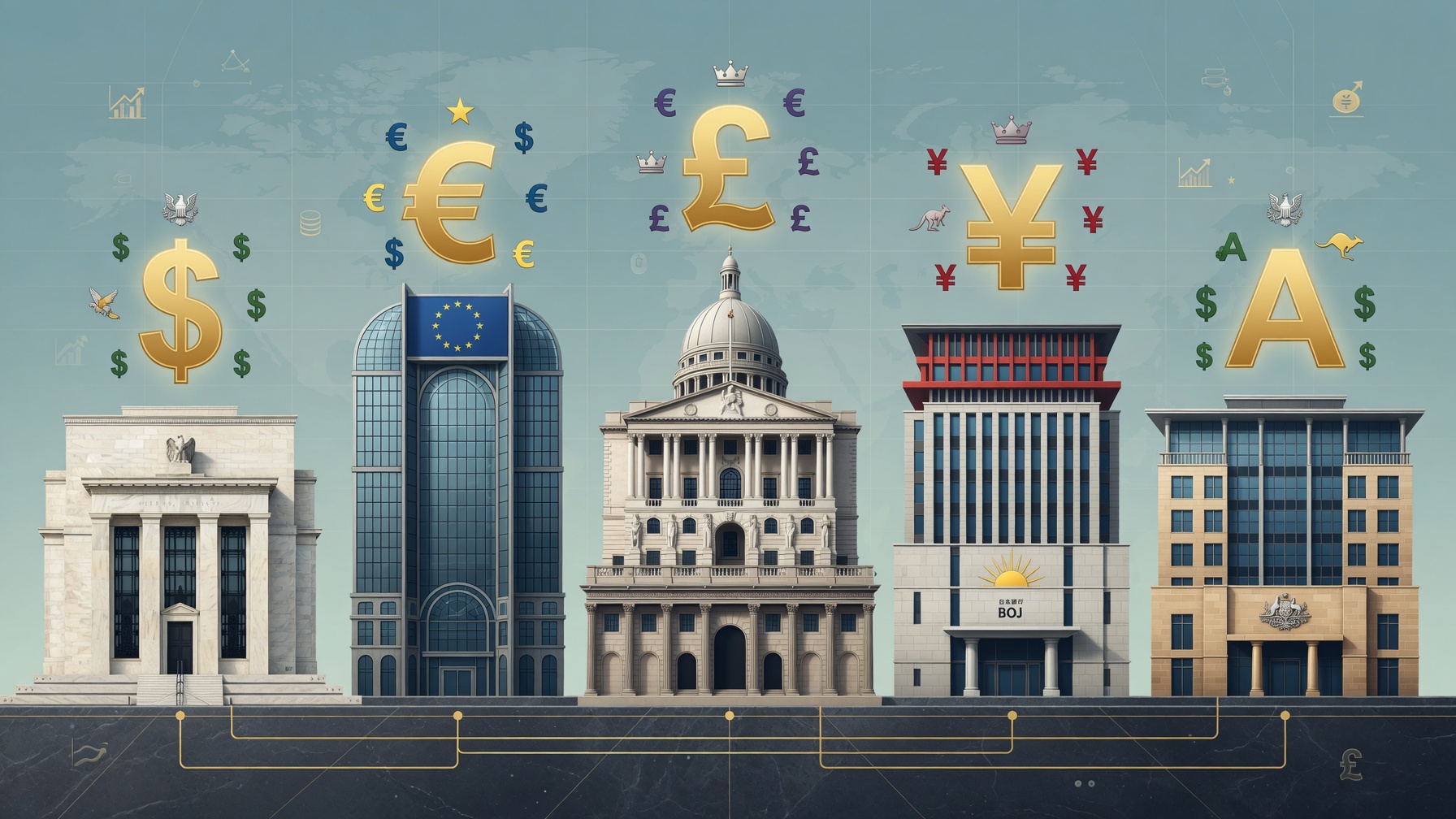
The Federal Reserve (Fed) is the most influential central bank in the world because the US dollar is involved in approximately 88% of all forex transactions. The Fed's dual mandate of price stability and maximum employment means it responds to both inflation and labor market data. Markets parse every word of FOMC statements and press conferences for clues about future policy direction. The European Central Bank (ECB) sets policy for the Eurozone and focuses primarily on price stability, targeting inflation near but below 2%. ECB President press conferences are major market events, and the ECB is known for using forward guidance extensively. The Bank of England (BOE) has an inflation target of 2% and meets monthly to set rates. The BOE's Monetary Policy Committee votes are published with individual member names, providing unique insight into the diversity of views within the committee. The Bank of Japan (BOJ) has fought deflation for decades and maintains an ultra-loose monetary policy stance, including negative interest rates and yield curve control. BOJ interventions and policy surprises are among the most market-moving events in yen pairs. The Swiss National Bank (SNB) is unique for its willingness to intervene directly in currency markets, and the Reserve Bank of Australia (RBA) and Reserve Bank of New Zealand (RBNZ) are known for their relatively transparent policy communication.
How to Trade Around Central Bank Events
Central bank events — rate decisions, meeting minutes, press conferences, and economic projections — create some of the highest volatility in the forex market. Here is how to approach them safely and profitably. First, always check the economic calendar at the start of each week and note all scheduled central bank events during your trading hours. Reduce your position sizes by at least 50% before high-impact events, as spreads can widen dramatically and slippage can cause stop losses to be filled far from your intended level. Avoid entering new trades 30 to 60 minutes before a major announcement. If you have existing positions, consider tightening your stop losses or reducing position size to limit exposure.
When the announcement is released, do not trade the initial spike. The first few seconds after a rate decision or statement release are pure chaos — prices spike instantly in one direction, then often reverse just as quickly as the market digests the details. Wait for the initial volatility to settle, typically 15 to 30 minutes, and then assess the market's direction. Pay close attention to the accompanying statement and press conference — the tone and language used by central bank officials often matter more than the rate decision itself. A rate hold with a hawkish tone (signaling future hikes) can strengthen a currency more than an actual rate hike with a dovish tone. Learn to interpret phrases like "vigilant," "monitoring closely," "patient," and "prepared to act" as signals of future policy direction.
Understanding Hawkish vs Dovish Policy
"Hawkish" refers to a central bank that is more concerned about inflation and inclined to raise interest rates or tighten monetary policy. Hawkish policy tends to strengthen the currency because higher rates attract capital. "Dovish" refers to a central bank that is more concerned about economic growth and employment and inclined to cut rates or ease policy. Dovish policy tends to weaken the currency. Markets constantly assess the balance between hawkish and dovish voices within central bank committees, and shifts in this balance drive significant currency movement. When a central bank that was previously dovish becomes more hawkish, the currency typically rallies as the market prices in expected rate hikes. The opposite triggers currency weakness.
Conclusion
Central banks are the most powerful force in the forex market, and understanding their policies, tools, and communication style is essential for every trader. The Federal Reserve, ECB, BOE, BOJ, and other major central banks drive the long-term trends that technical analysis helps you trade. Master the tools they use — interest rates, quantitative easing, forward guidance, and currency intervention — and learn to interpret their communication for clues about future policy direction. Reduce risk before major central bank events, wait for volatility to settle before entering trades, and pay more attention to the tone of statements and press conferences than to the rate decision itself. When you understand what central banks want and how they plan to achieve it, you gain a fundamental edge that complements your technical analysis and positions you to profit from the most powerful forces moving the forex market.
A passionate writer and content creator.
Community Comments
Please log in to comment on this blog post.
Log InNo comments yet. Be the first to comment!