
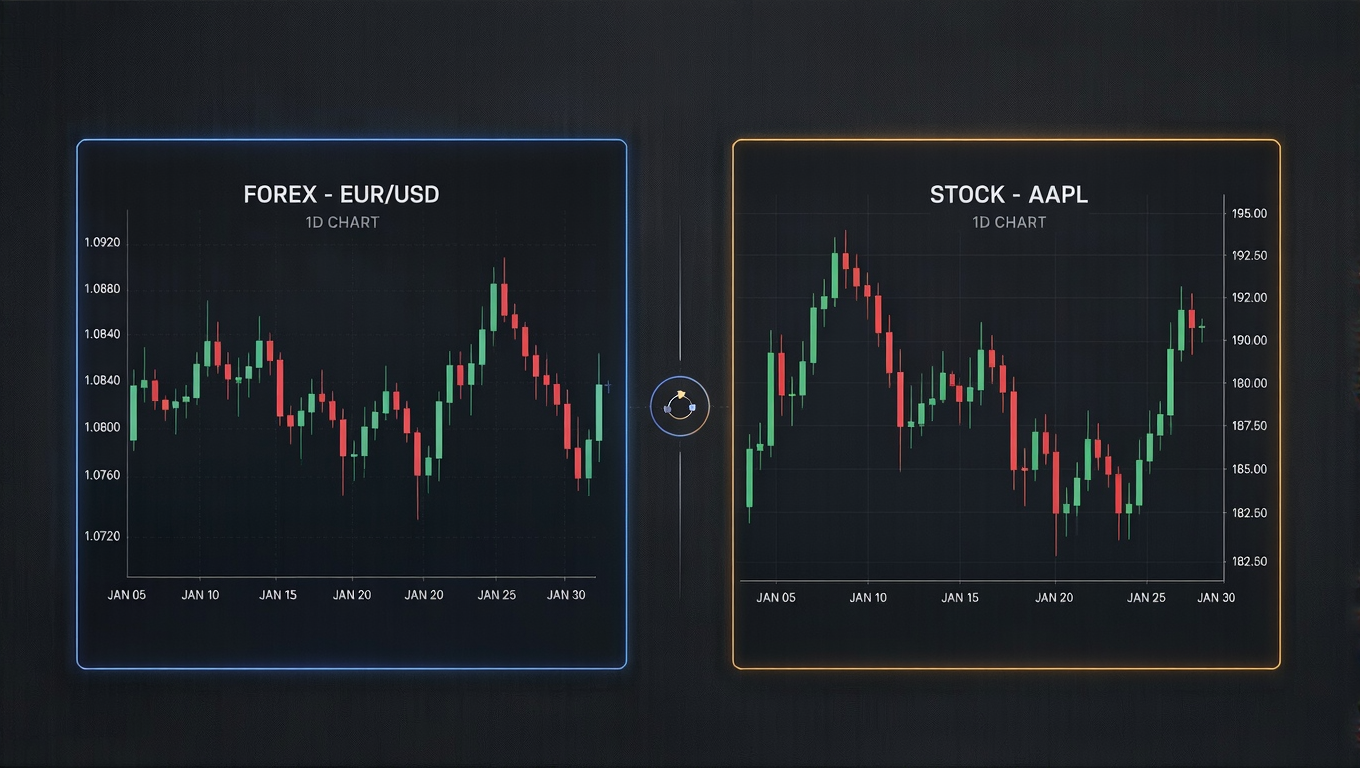
Two Different Worlds: Forex vs Stocks
Forex and stock markets operate very differently. Understanding these differences is essential because the market you choose will shape your trading journey — from the hours you trade and the leverage you use to the analysis techniques you rely on and the costs you pay. While some traders specialize in one market, many find that understanding both helps them make better trading decisions overall. Let us explore the critical distinctions between forex and stock trading so you can decide which path suits you best.
Market Hours and Accessibility
The forex market operates 24 hours a day, five days a week, spanning the major financial centers of Sydney, Tokyo, London, and New York. This round-the-clock schedule means you can trade whenever it fits your lifestyle — whether that is early morning before work, during lunch, or late at night. Stock markets, by contrast, have fixed trading hours tied to their respective exchanges. The New York Stock Exchange, for example, opens at 9:30 AM and closes at 4:00 PM Eastern Time. After-hours trading exists but suffers from lower liquidity and wider spreads. If you have a day job and can only trade outside standard business hours, forex offers a clear advantage.
Liquidity and Market Size
Forex is the most liquid financial market in the world, with over $7.5 trillion traded daily. This massive liquidity means you can enter and exit positions of virtually any size without significantly affecting the price. Individual stocks vary enormously in liquidity — major blue-chip stocks like Apple or Microsoft trade millions of shares daily with tight spreads, while small-cap stocks may trade only a few thousand shares per day with wide bid-ask spreads that make trading expensive and difficult. For traders who value the ability to execute large orders quickly at predictable prices, forex liquidity is unmatched. However, the stock market offers a vastly wider range of instruments. While forex has roughly 50 to 70 actively traded currency pairs, the stock market offers thousands of individual companies across every sector of the economy, giving stock traders far more diversification and thematic trading opportunities.
Leverage: A Tale of Two Markets
- Forex leverage — routinely offered at 30:1, 50:1, or even 100:1 and 500:1 in some jurisdictions. This means a $1,000 account can control $50,000 to $500,000 in currency. The upside is amplified, but so is the risk — a 1% to 2% move against you can wipe out your entire account at the highest leverage levels.
- Stock leverage — typically limited to 2:1 for day trading and 4:1 for overnight positions under FINRA rules in the United States. Pattern day traders must maintain a minimum $25,000 account to use margin. International brokers may offer higher leverage, but stock leverage is generally far lower than forex.
- Practical impact — forex allows you to generate meaningful returns from a small account, which is why it attracts beginners. Stock trading typically requires more capital to achieve the same dollar returns. However, the lower leverage in stocks makes it harder to blow up your account, which can be a blessing for inexperienced traders.
Trading Costs Compared
Forex trading costs are built into the spread — the difference between the bid and ask price. There are no exchange fees, clearing fees, or per-share commissions on most forex accounts (though some brokers charge a small commission on raw-spread accounts). Stock trading costs are more varied and include broker commissions (though many brokers now offer commission-free trading), exchange fees, SEC and FINRA fees, and potentially pattern day trading penalties. For small accounts making frequent trades, forex tends to be cheaper. For large accounts making infrequent trades, the cost difference becomes negligible. Spreads in forex widen during volatile periods and can be significantly higher for exotic pairs, while stock trading costs remain relatively stable regardless of the company being traded.
Analysis and Strategy Differences
Forex trading relies heavily on macroeconomic analysis — interest rates, employment data, GDP, inflation, and central bank policy drive currency values. Technical analysis works well in forex because of the market's high liquidity and tendency to respect key support and resistance levels. Stock trading incorporates these factors plus company-specific analysis: earnings reports, revenue growth, profit margins, competitive positioning, management quality, and industry trends. Stock traders can use fundamental analysis to value a company and determine whether it is overpriced or underpriced, which is harder to do with currencies since no single valuation metric exists. Many stock traders are long-term investors who buy and hold for years, while most forex traders are short-term speculators who hold positions for hours or days.
Which Market Should You Choose?
The answer depends on your personal circumstances. Choose forex if you have limited capital (under $2,000), need flexible trading hours, prefer technical analysis, and can handle the emotional discipline required for high-leverage trading. Choose stocks if you have more capital, are interested in fundamental analysis and company research, prefer lower leverage that protects you from catastrophic losses, or want to trade specific sectors and themes. There is no universally better market — many professional traders participate in both. The best approach is to open demo accounts in both markets, trade each for one to two months, and see which feels more natural to your personality and aligns better with your goals.
Conclusion
Forex and stock each offer unique advantages and challenges. Forex provides 24-hour access, unmatched liquidity, high leverage that enables small accounts to generate meaningful returns, and simpler cost structures based on spreads. Stock markets offer thousands of instruments for diversification, lower leverage that protects beginners from catastrophic losses, and the opportunity to use both technical and fundamental analysis based on company-specific data. Neither market is inherently better — the right choice depends on your capital, schedule, risk tolerance, and preferred analytical approach. Trade on demo first, be honest about your strengths and weaknesses, and remember that the best market is the one you can trade consistently and profitably over the long term.

A passionate writer and content creator.
Community Comments
Please log in to comment on this blog post.
Log InNo comments yet. Be the first to comment!