
Understanding Trading Costs
Every trade costs money. Whether you win or lose, the spread and any applicable commissions are paid every time you open and close a position. Understanding these costs is essential for calculating your true profitability. Many beginners focus exclusively on potential profits while ignoring the costs embedded in each trade, only to discover later that their winning trades barely broke even after accounting for spreads and commissions. Trading costs directly reduce your net profit and increase the breakeven threshold for every position you take.
The total cost of a trade is determined by several factors: the spread, any commission charged by the broker, swap rates for overnight positions, and potential currency conversion fees if your account currency differs from the pair you are trading. Each of these components eats into your bottom line, and their relative importance depends heavily on your trading style. A scalper who takes fifty trades per day cares enormously about spreads and commissions, while a swing trader who holds positions for weeks may be more concerned with swap rates and slippage during major news events.
What Is a Spread?
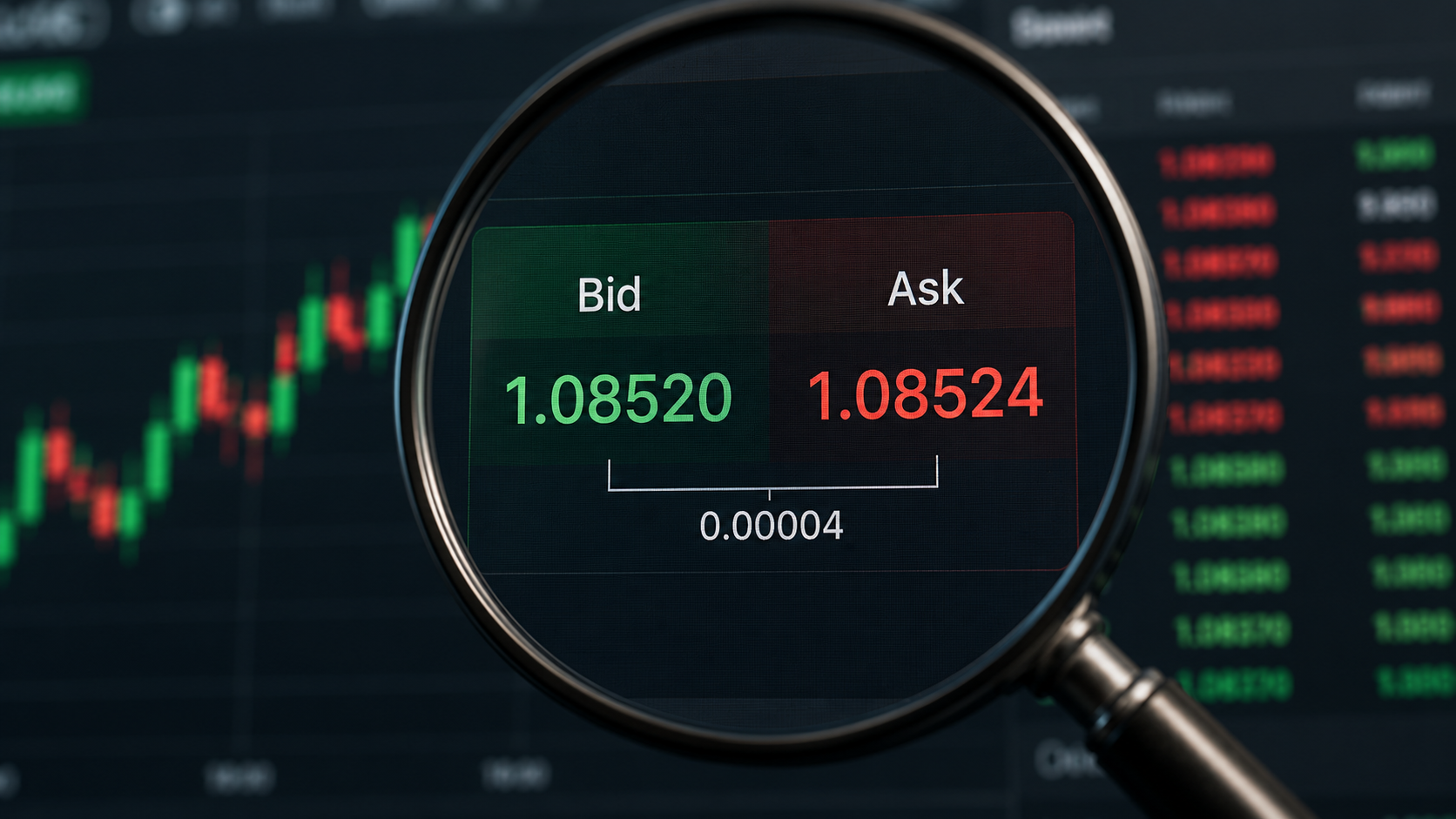
The spread is the difference between the bid (sell) price and the ask (buy) price. Tight spreads (0.5-1.5 pips on major pairs) are typical for ECN brokers who offer direct market access. Market makers may offer fixed spreads but these often widen significantly during news events or volatile market conditions. The spread represents the broker's compensation for facilitating your trade, and it is effectively the first hurdle your trade must overcome to become profitable. If you enter a trade and the spread is 2 pips, you immediately lose 2 pips of value as soon as you click buy or sell.
Spreads vary by currency pair, market session, and volatility. Major pairs like EUR/USD and GBP/USD have the tightest spreads — often 0.5 to 1.0 pips during peak London-New York overlap. Cross pairs like EUR/GBP have wider spreads, typically 1.5 to 3.0 pips. Exotic pairs involving emerging market currencies can have spreads of 5 to 20 pips or more. Spreads also widen during low-liquidity periods such as the Asian session, during holidays, and before and after major economic data releases. Understanding when spreads are tightest helps you time your trades for maximum cost efficiency.
Commission vs Spread-Only
- Spread-only accounts — no commission is charged, but spreads are wider to compensate. The broker builds their fee entirely into the spread. This model is simpler and more transparent for casual traders, but the wider spreads mean higher costs per trade.
- Raw spread + commission accounts — the spread is reduced to the raw interbank level (often 0.0 to 0.2 pips), and a fixed commission is charged per lot traded. Typical commissions are $3 to $7 per standard lot round-turn (both entry and exit). This model is generally cheaper for high-volume traders.
- Calculate which model costs less for your trading frequency and style. A simple formula: annual cost = (average spread + commission) × number of trades per year × position size. Run this calculation for both account types to see which one suits you better.
How to Choose the Right Account Type
Scalpers need the tightest possible spreads — raw pricing with commission is almost always better, as even a fraction of a pip difference adds up dramatically over hundreds of trades. A scalper taking 50 trades per day saving just 0.5 pips per trade saves thousands of dollars per year. Day traders benefit from the raw spread model as well, though the advantage is less extreme. Swing traders who trade only a few times per month may prefer spread-only accounts since the commission-free structure and wider spreads matter less over fewer trades. Always compare the total round-turn cost — spread plus commission — between account types and broker options before committing.
Additional Costs to Consider
Swap rates (also called rollover or overnight financing) are charged when you hold a position past 5:00 PM EST. If you hold a position overnight, you either pay or receive interest depending on the interest rate differential between the two currencies in your pair. Positive swap can add to your profits over time, while negative swap eats into them. Currency conversion fees apply when your trading account currency differs from the quote currency of the pair you are trading — these can be significant if you frequently trade cross pairs. Always check your broker's fee schedule thoroughly before depositing real money to avoid unpleasant surprises.
Conclusion
Trading costs are an unavoidable reality of forex trading, but understanding them allows you to minimize their impact on your profitability. Choose your account type based on your trading frequency, compare total round-turn costs between brokers, and factor in swap rates and conversion fees when calculating your expected returns. The most successful traders are obsessed with cost efficiency because they understand that small savings on each trade compound into significant advantages over hundreds and thousands of trades. Master your costs, and you give yourself a meaningful edge in the competitive world of forex trading.

A passionate writer and content creator.
Community Comments
Please log in to comment on this blog post.
Log InNo comments yet. Be the first to comment!