
Currency Correlation: How Pairs Move Together and Apart

What Is Currency Correlation and Why It Matters
Currency correlation measures how two currency pairs move in relation to each other. A positive correlation means the pairs tend to move in the same direction — when one rises, the other tends to rise as well. A negative correlation means they move in opposite directions — when one rises, the other tends to fall. Correlation is expressed as a coefficient ranging from +1.0 (perfect positive correlation — pairs move identically) through 0 (no correlation) to -1.0 (perfect negative correlation — pairs move in exact opposite). In practice, correlations are rarely perfect, but understanding them is essential for portfolio risk management and trade selection.
Why does correlation matter to your trading? The most immediate reason is risk concentration. If you simultaneously hold long positions in EUR/USD and GBP/USD — two pairs with strong positive correlation — you are effectively doubling your exposure to the same market move. A dollar-strengthening event that hits both pairs will cause losses in both positions, doubling your risk beyond what your position sizing intended. Similarly, if you are long EUR/USD and short USD/CHF (strong negative correlation), you may be unintentionally hedging yourself, neutralizing your exposure while still paying spreads and commissions on both trades. Understanding correlation allows you to build a portfolio of trades that genuinely diversifies risk rather than concentrating it in a single market factor.
Common Correlation Patterns Among Major Pairs
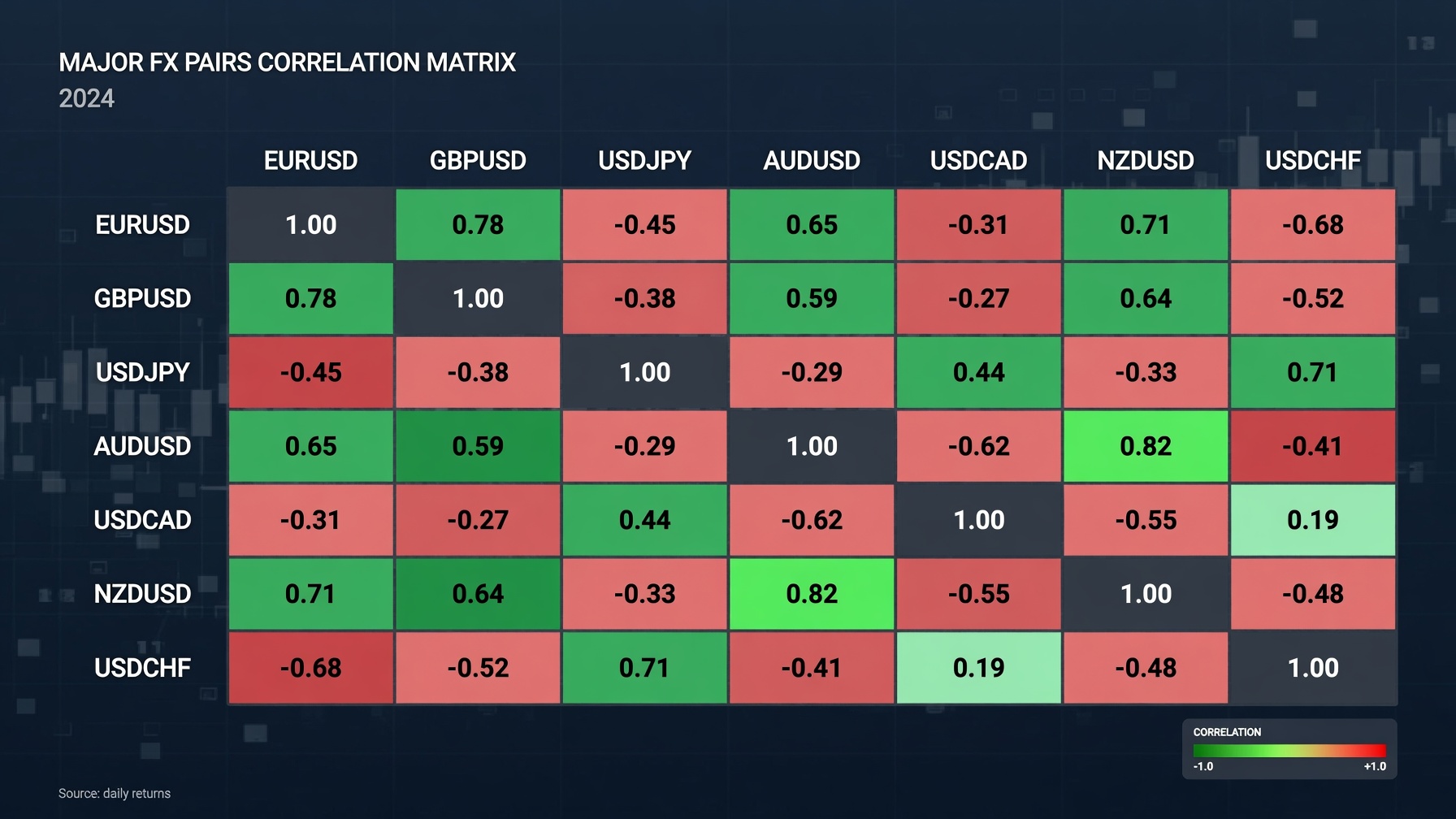
- EUR/USD and GBP/USD — strong positive correlation (typically +0.70 to +0.90). Both pairs have USD as the quote currency and are heavily influenced by the same dollar-driven factors. When the dollar strengthens, both pairs tend to fall together. When you trade both simultaneously, your total portfolio risk is approximately 1.7 to 1.9 times your single-pair risk, depending on the current correlation strength.
- USD/CHF and EUR/USD — strong negative correlation (typically -0.85 to -0.95). USD/CHF is effectively the inverse of EUR/USD because the Swiss Franc is heavily influenced by Eurozone economic conditions. When EUR/USD rises, USD/CHF tends to fall by a similar amount. Trading both pairs in the same direction effectively cancels out your exposure, which is useful if you want to neutralize a position without closing it.
- AUD/USD and NZD/USD — strong positive correlation (typically +0.75 to +0.90). Both are commodity-linked currencies driven by similar factors — demand for Australian and New Zealand commodities, Chinese economic growth, and global risk sentiment. Trading both in the same direction multiplies your risk; trading them in opposite directions can be risky if the correlation suddenly strengthens.
- USD/JPY and USD/CAD — moderate positive correlation (typically +0.40 to +0.60). While both have USD as the base currency, their movements are influenced by different factors — USD/JPY by risk sentiment and interest rate differentials, USD/CAD by oil prices and Canadian economic data. They share some common dollar-driven movement but have significant independent components.
- GBP/JPY and EUR/JPY — strong positive correlation (typically +0.80 to +0.90) because both have JPY as the quote currency. Japanese yen crosses tend to move together, especially during risk-on/risk-off shifts in global markets. Trading multiple yen crosses in the same direction significantly concentrates risk in the yen.
Why Correlation Changes Over Time
Correlations are not fixed — they change over time based on market conditions, economic events, and shifting trader behavior. During risk-on periods (when investors are optimistic and buying riskier assets), risk-sensitive pairs like AUD/USD, NZD/USD, and USD/CAD tend to move more closely together as they all benefit from positive risk sentiment. During risk-off periods (crises, uncertainty), safe-haven currencies like USD, JPY, and CHF strengthen together, creating positive correlations among them that may not exist during calm periods. Correlations also change during major economic events — a surprise interest rate decision can temporarily break down established correlation patterns as traders reassess the fundamental relationships between currencies. This is why you should never assume a historical correlation will hold in the current moment. Check recent correlation data before every multi-pair trade decision.
How to Use Correlation in Your Trading
The primary use of correlation analysis is risk management. Before opening a second position, check the correlation between the new pair and your existing positions. If the correlation is strongly positive, you are effectively increasing your risk on the same underlying market move. Either reduce the position sizes of both trades so that the combined risk equals your target (e.g., risk 0.5% on each instead of 1% when trading two highly correlated pairs), or choose a different pair that provides genuine diversification. Another valuable application is hedging: if you have a long position that you cannot close but want to protect against short-term downside, you can open a short position in a highly correlated pair as a temporary hedge. However, this strategy must be executed carefully because correlations can break down, leaving you exposed in both directions.
Monitoring Correlation: Practical Tools and Methods
Most trading platforms offer built-in correlation tools or you can calculate correlations manually using a spreadsheet. A 20-day rolling correlation coefficient provides a current picture of pair relationships — calculate the daily percentage changes for both pairs over the last 20 trading days and compute the Pearson correlation coefficient. Many forex websites and broker platforms display real-time correlation matrices that color-code the strength and direction of correlations between major pairs, making it easy to check at a glance. Make it a habit to review the correlation matrix at the start of each trading week, especially if you plan to hold multiple positions simultaneously. Pay particular attention to pairs whose correlation has recently shifted — a pair that was historically uncorrelated but has become highly correlated represents a change in market dynamics that you need to account for in your risk calculations.
Correlation and Portfolio Diversification
True diversification in forex means holding positions in uncorrelated or negatively correlated pairs. For example, combining a long EUR/USD trade with a long USD/CAD trade exposes you to two different market drivers — eurozone vs Canadian economic conditions — reducing your overall portfolio risk. Combining a long position in a pair with a short position in a negatively correlated pair can create a market-neutral strategy that profits from relative strength rather than directional movement. However, be cautious with negatively correlated pairs: the correlation can shift unexpectedly, especially during major news events, leaving both positions moving against you. Proper position sizing across a correlated portfolio requires you to treat your entire portfolio as a single risk unit, calculating the total combined risk across all open positions and ensuring it stays within your overall risk tolerance.
Conclusion
Currency correlation is a critical concept for any trader who holds multiple positions simultaneously. Understand that EUR/USD and GBP/USD move together, USD/CHF is the inverse of EUR/USD, and commodity dollar pairs (AUD, NZD, CAD) have their own correlation dynamics. Adjust your position sizes when trading correlated pairs to keep your total portfolio risk at your target level — if you trade two highly correlated pairs, risk half your usual amount on each. Check recent correlation data regularly because correlations change with market conditions. Use correlation to build a genuinely diversified portfolio of trades and avoid the hidden risk concentration that occurs when multiple positions all depend on the same market driver. When you master correlation analysis, you transform your trading from a series of isolated bets into a structured portfolio where each position contributes meaningful, diversified exposure.
A passionate writer and content creator.
Community Comments
Please log in to comment on this blog post.
Log InNo comments yet. Be the first to comment!