
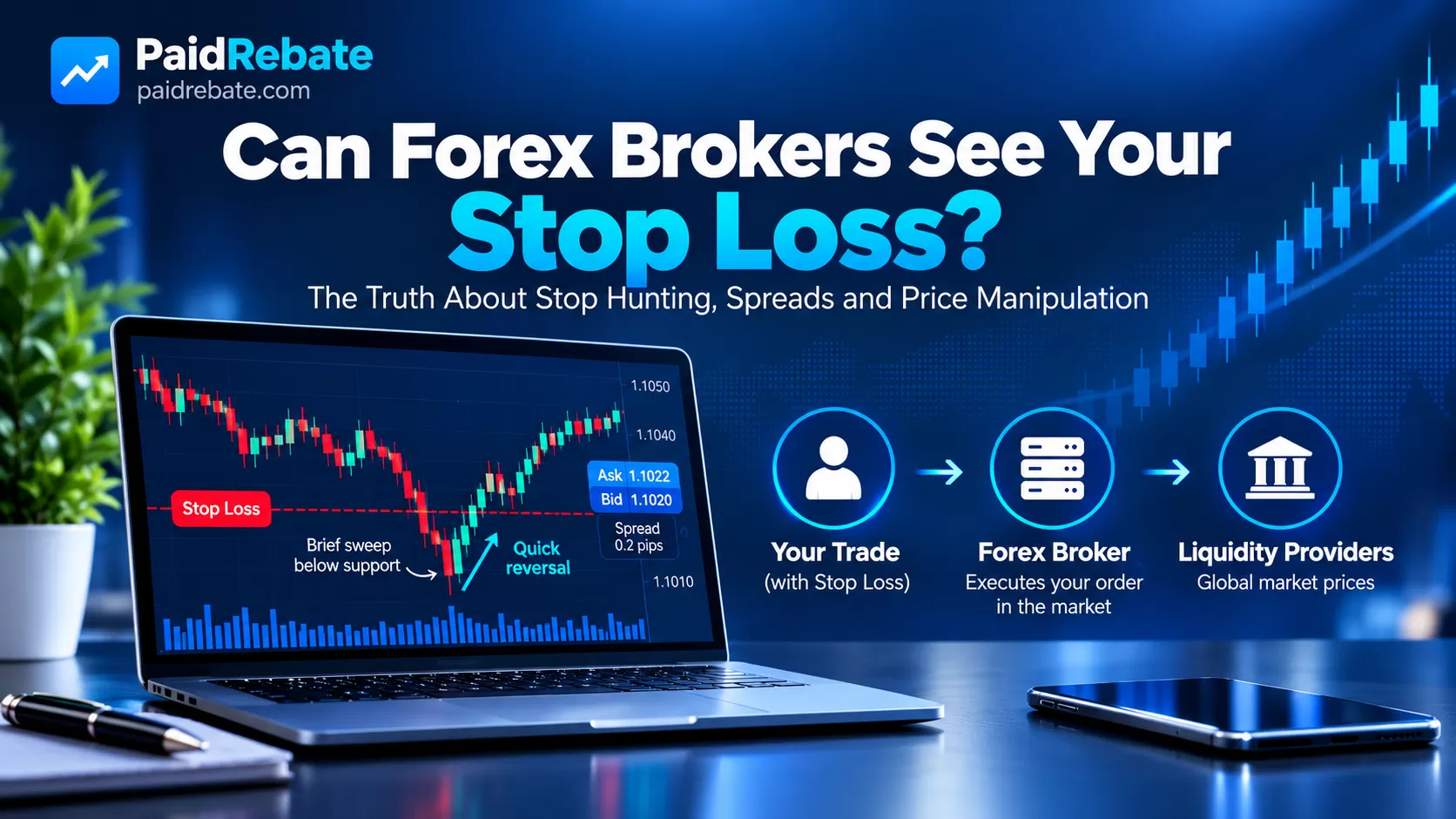
Can Forex Brokers See Your Stop Loss? The Truth About Stop Hunting

Can Forex Brokers See Your Stop Loss? Stop Hunting Explained
You place a forex trade, set your Stop Loss, and walk away.
A few minutes later, your position closes.
Then, almost immediately, the market reverses and moves in the direction you originally expected.
So naturally, you start wondering:
Did my broker hunt my Stop Loss?
The answer is not always as simple as it seems.
Sometimes a Stop Loss is triggered because of a wider Bid/Ask spread, increased volatility, slippage, or the difference between the price shown on your chart and the actual executable price.
At the same time, execution quality matters—and traders should understand exactly how their broker handles orders.
Let's break it down.
Can a Forex Broker See Your Stop Loss?
In many cases, yes.
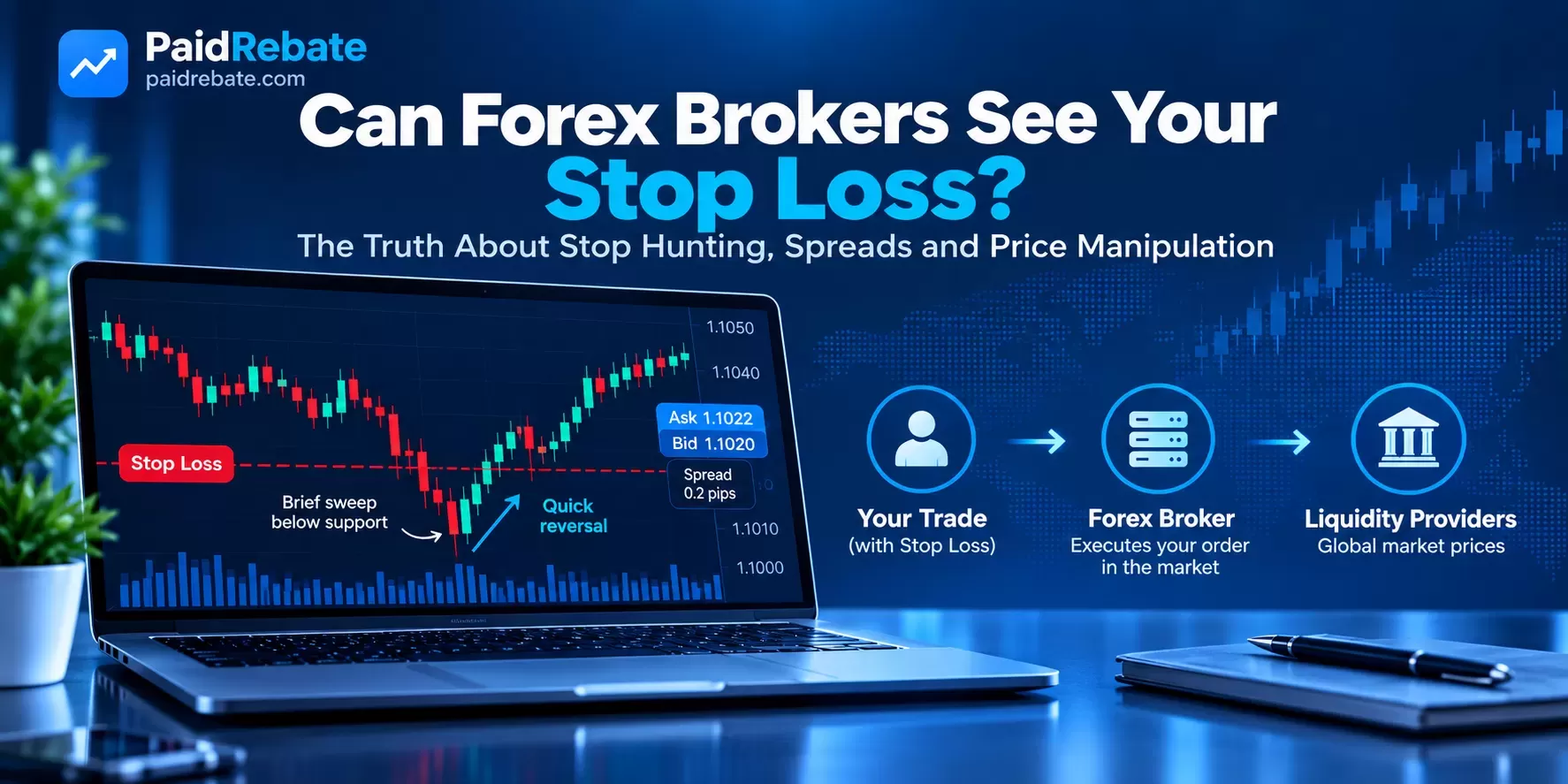
If you place a normal Stop Loss directly through your trading platform, the trading infrastructure managing your position needs access to that instruction.
For example, MetaTrader 5 states that normal Stop Loss and Take Profit instructions are stored and executed on the broker's server.
That means a server-side Stop Loss is not a secret level known only to you.
But there is an important difference between a normal server-side Stop Loss and what traders often call a virtual or hidden Stop Loss.
Server-Side Stop Loss
A server-side Stop Loss is submitted to the broker with your trade.
Once accepted, the level is maintained by the broker's trading server.
One major advantage is that it can continue working even if:
-
Your computer shuts down
-
Your internet connection is lost
-
Your trading terminal disconnects
The trade-off is straightforward:
The broker's server needs to know the Stop Loss level in order to execute it.
Virtual or Hidden Stop Loss
Some Expert Advisors use what traders call a virtual or hidden Stop Loss.
Instead of sending the Stop Loss level to the broker in advance, the EA monitors the market locally.
When its internal Stop Loss level is reached, the software sends an instruction to close the trade.
This can mean that no server-side Stop Loss exists before the closing instruction is sent.
However, there is another risk.
If the EA, VPS, internet connection, or trading terminal fails, the virtual Stop Loss may not operate as intended.
So a hidden Stop Loss isn't automatically safer.
It simply changes where the exit logic is managed.
Does Knowing Your Stop Loss Mean the Broker Is Hunting It?
No.
This distinction is extremely important.
A broker's trading system knowing the location of your Stop Loss does not prove that the broker deliberately manipulated the market to trigger it.
The broker needs order information to execute trades and manage risk. It may also analyze overall customer exposure, including concentrations of long and short positions.
But there is a major difference between:
Having access to customer order information
and
Deliberately using unfair execution or artificial pricing against customers.
These are two completely different claims.
If you suspect manipulation, evidence matters far more than the fact that your Stop Loss was visible to the trading server.
What Do Traders Mean by Stop Loss Hunting?
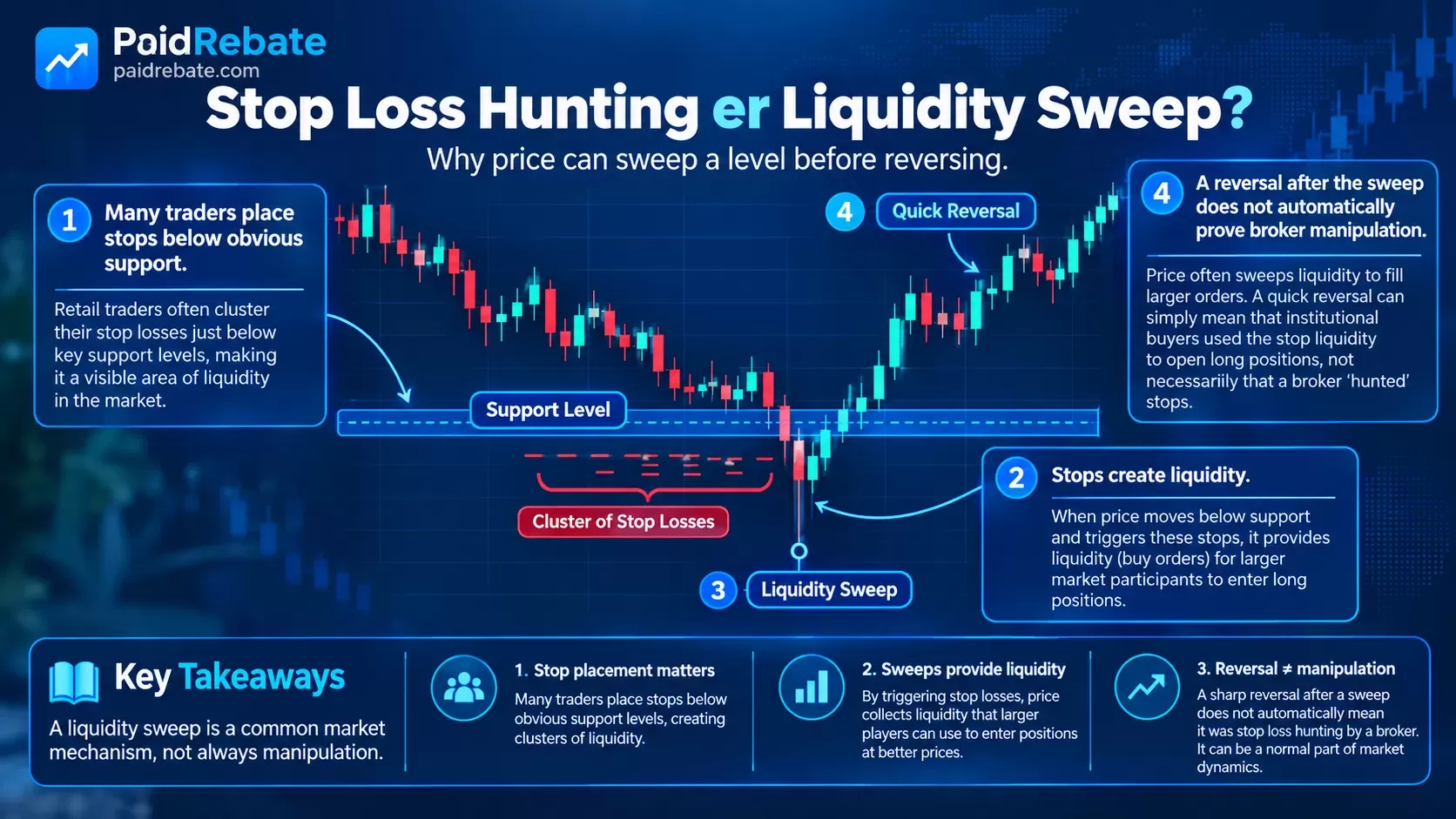
Forex traders commonly use the term Stop Loss hunting when price moves through an obvious technical level, triggers multiple Stop Loss orders, and then quickly reverses.
For example, imagine EUR/USD repeatedly holds above a support level.
Many traders buy around that support and place their Stop Losses just underneath it.
Then price suddenly drops below support.
Multiple Stop Losses are triggered.
A few moments later, price rebounds.
From the trader's perspective, it can look like someone deliberately targeted those Stop Losses.
But there is another possible explanation:
normal market structure.
Stop Loss orders often cluster around predictable areas such as:
-
Previous highs and lows
-
Support and resistance
-
Round numbers
-
Session highs and lows
-
Major breakout levels
When price reaches one of these areas, many orders can activate at approximately the same time.
That can create a rapid burst of liquidity and accelerate the movement.
Traders often describe this type of movement as a liquidity sweep.
A liquidity sweep, by itself, is not proof that your broker manipulated the market.
Why Did My Stop Loss Trigger When the Chart Never Touched It?
This is one of the most misunderstood aspects of forex trading.
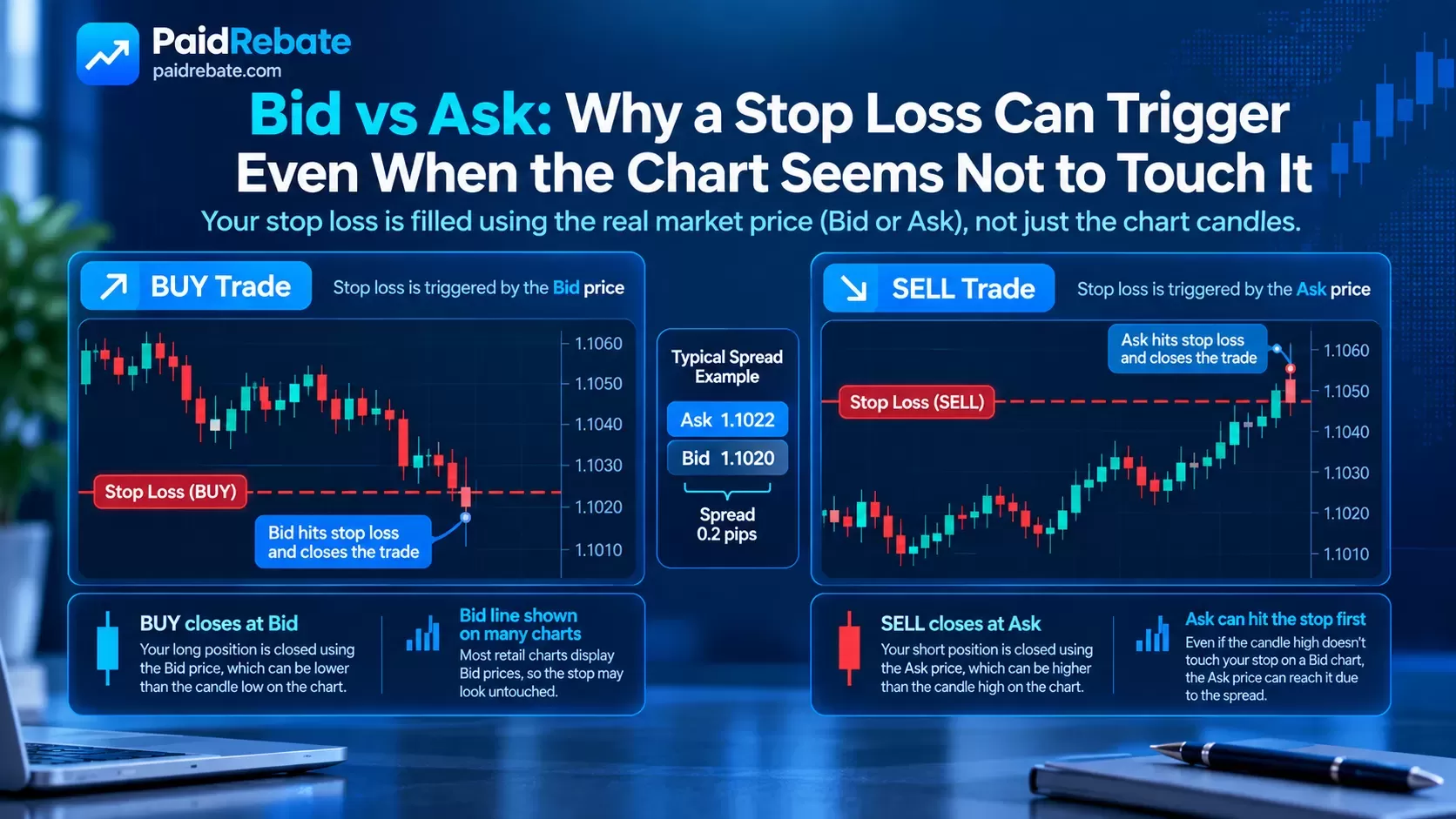
The answer is often the Bid/Ask spread.
Forex trading involves two prices:
Bid
The price at which you can sell.
Ask
The price at which you can buy.
Depending on the instrument and position type, your Stop Loss can be triggered by a price that isn't the same price displayed on the main chart. MetaTrader documentation describes Bid as the relevant Stop Loss trigger for long positions and Ask for short positions.
| Position | Price Relevant to Stop Loss |
|---|---|
| BUY / Long | Bid |
| SELL / Short | Ask |
Example
Suppose you have a SELL trade with a Stop Loss above the current market.
Your chart may primarily display the Bid price.
The Bid may never visibly reach your Stop Loss.
But if the Ask price reaches that level, your Stop Loss can still be triggered.
So the chart may appear to show something different from what actually happened to the executable price.
That's why displaying both Bid and Ask information can be useful when investigating a Stop Loss.
Can a Wider Spread Trigger Your Stop Loss?
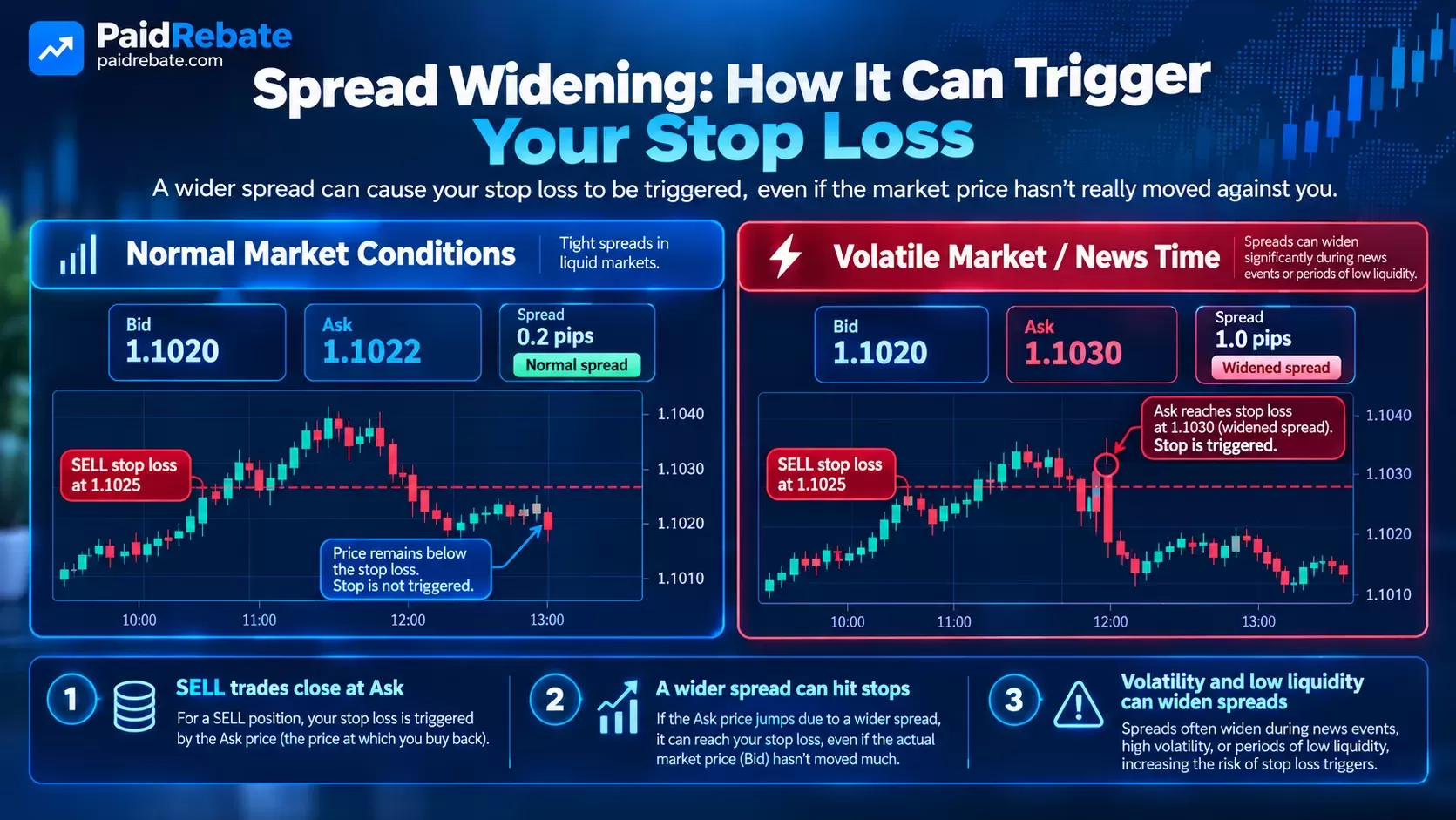
Yes.
Consider a simple EUR/USD example.
Normal market conditions
Bid: 1.1000
Ask: 1.1002
Spread: 2 pips
Now imagine liquidity becomes thin and the spread suddenly widens.
Bid: 1.1000
Ask: 1.1010
Spread: 10 pips
Notice what happened.
The Bid barely moved.
But the Ask increased significantly because the spread widened.
If you were holding a SELL position with a Stop Loss at 1.1008, the Ask could reach that level and trigger your Stop Loss—even though the Bid chart never displayed 1.1008.
To someone looking only at the Bid candles, it may look as though the broker closed the trade at a price that never existed.
But the missing information may simply be the Ask price.
Why Do Forex Spreads Suddenly Widen?
Forex spreads aren't always fixed.
When liquidity is deep and markets are calm, Bid and Ask prices are usually closer together.
During unstable or thin market conditions, the spread can increase significantly.
Spread widening is particularly common around:
-
Major economic announcements
-
Central-bank decisions
-
Unexpected geopolitical events
-
Daily rollover
-
Market openings
-
Holidays
-
Sudden market gaps
-
Periods of low liquidity
Gold, indices, exotic currencies, and some CFDs can also experience noticeable spread changes.
However:
A wider spread does not automatically mean the broker manipulated the market.
A more useful question is:
Was the spread reasonable compared with other credible market sources at the same moment?
That is something you can investigate.
What Is Slippage?
Slippage occurs when an order is executed at a different price from the price you expected when the order was submitted or triggered.
For example, suppose you expect EUR/USD to close at:
1.08500
But the available execution price is:
1.08485
The difference is 1.5 pips.
Slippage can occur because financial markets continue moving while orders are being transmitted and executed.
During a fast market, the price visible on your screen may no longer be available when the order reaches the execution venue or dealer.
Therefore:
Slippage alone is not evidence of wrongdoing.
Positive vs. Negative Slippage
Slippage can occur in both directions.
Negative Slippage
You receive a worse price than expected.
Positive Slippage
You receive a better price than expected.
For an individual trade, either outcome can occur naturally.
What becomes more interesting is a repeated pattern.
If a large number of eligible trades consistently receive unfavorable slippage when prices move against the trader—but rarely receive favorable execution when prices move in the trader's favor—the execution model deserves closer examination.
Historical enforcement cases have demonstrated why execution statistics can matter. The National Futures Association documented a case involving FXDD concerning asymmetric treatment of price slippage.
That historical case does not mean normal slippage is manipulation.
It shows why traders should examine execution data rather than relying on assumptions.
Can Forex Brokers Manipulate Prices?
A more useful way to look at this question is:
How does the broker's execution infrastructure determine the prices and fills you receive?
Retail OTC forex is different from trading directly through a centralized exchange.
Depending on the broker and account structure, the broker may:
-
Act as the customer's counterparty
-
Hedge exposure elsewhere
-
Obtain prices from liquidity providers
-
Aggregate multiple price sources
-
Apply disclosed markups
-
Manage customer orders according to its execution policy
Therefore, small differences between brokers are normal.
However, unusual execution may deserve investigation.
For example, consider a situation where:
-
One broker shows an isolated price spike
-
Several independent feeds do not show a comparable movement
-
The spike triggers your Stop Loss
That does not automatically prove manipulation.
But it does provide a reasonable basis to ask the broker for an explanation.
Repeated patterns are much more informative than one unusual trade.
Why Is My Broker's Price Different From TradingView?
Because there is no single universal spot-forex price displayed everywhere.
Forex is a decentralized market.
Different brokers can obtain pricing from different:
-
Banks
-
Non-bank liquidity providers
-
Aggregators
-
Market makers
-
Data feeds
They may also apply different spreads and markups.
So if:
Broker A: 1.08521
Broker B: 1.08525
That small difference does not automatically indicate anything unusual.
What deserves more attention is a significant isolated movement.
For example, if your broker shows a sudden spike that triggers your Stop Loss while several independent feeds show no comparable movement at the same time, the event may warrant investigation.
Does a B-Book Broker Benefit When You Lose?
Potentially, depending on how the broker manages its exposure.
A broker can act as a customer's counterparty while also hedging the resulting exposure elsewhere.
If a broker retains some customer exposure internally instead of hedging that specific risk, the customer's loss can economically contribute to a gain on the broker's internal dealing book.
This can create a potential conflict of interest.
However:
B-Book does not automatically mean Stop Loss hunting.
A properly operated market maker can internalize customer exposure while still providing fair pricing and execution.
Business model and execution conduct are separate questions.
Does A-Book Mean the Broker Is Automatically Better?
Not necessarily.
An A-Book broker may hedge or route exposure externally, which can reduce certain direct counterparty incentives.
But customers can still experience poor execution because of:
-
Liquidity conditions
-
Routing technology
-
Markups
-
Latency
-
Rejected orders
-
Slippage
-
Liquidity-provider quality
Therefore:
A-Book does not guarantee perfect execution.
And:
B-Book does not automatically prove manipulation.
Instead of choosing a broker based only on labels such as ECN, STP, A-Book, or No Dealing Desk, examine how the broker actually executes orders.
Can Your Broker See Where Many Traders Have Stops?
A broker managing server-side orders can potentially analyze information contained within its customer order book and risk-management systems.
This may include:
-
Customer positioning
-
Long/short exposure
-
Concentrations of server-side orders
But there is still a huge logical jump between:
The broker has customer order information
and:
The broker deliberately moved the market to trigger my individual Stop Loss.
Those are not the same thing.
For highly liquid markets such as EUR/USD, one retail trader's position is normally very small compared with overall global market activity.
Liquidity conditions can be different for smaller or less-liquid products.
Either way:
Evidence should come before accusations.
Why Does the Market Reverse Immediately After Your Stop Loss?
There are several normal explanations.
Your Stop Loss may have been placed just beyond an obvious support or resistance level where many other traders placed similar orders.
Other possibilities include:
-
Liquidity was concentrated around that price
-
The spread temporarily widened
-
The market traded through a liquidity area before reversing
-
Your Stop Loss simply happened to be near the turning point
It is frustrating when this happens.
But:
A reversal immediately after your Stop Loss does not prove that your broker targeted your trade.
How to Check Whether Your Stop Loss Was Executed Fairly
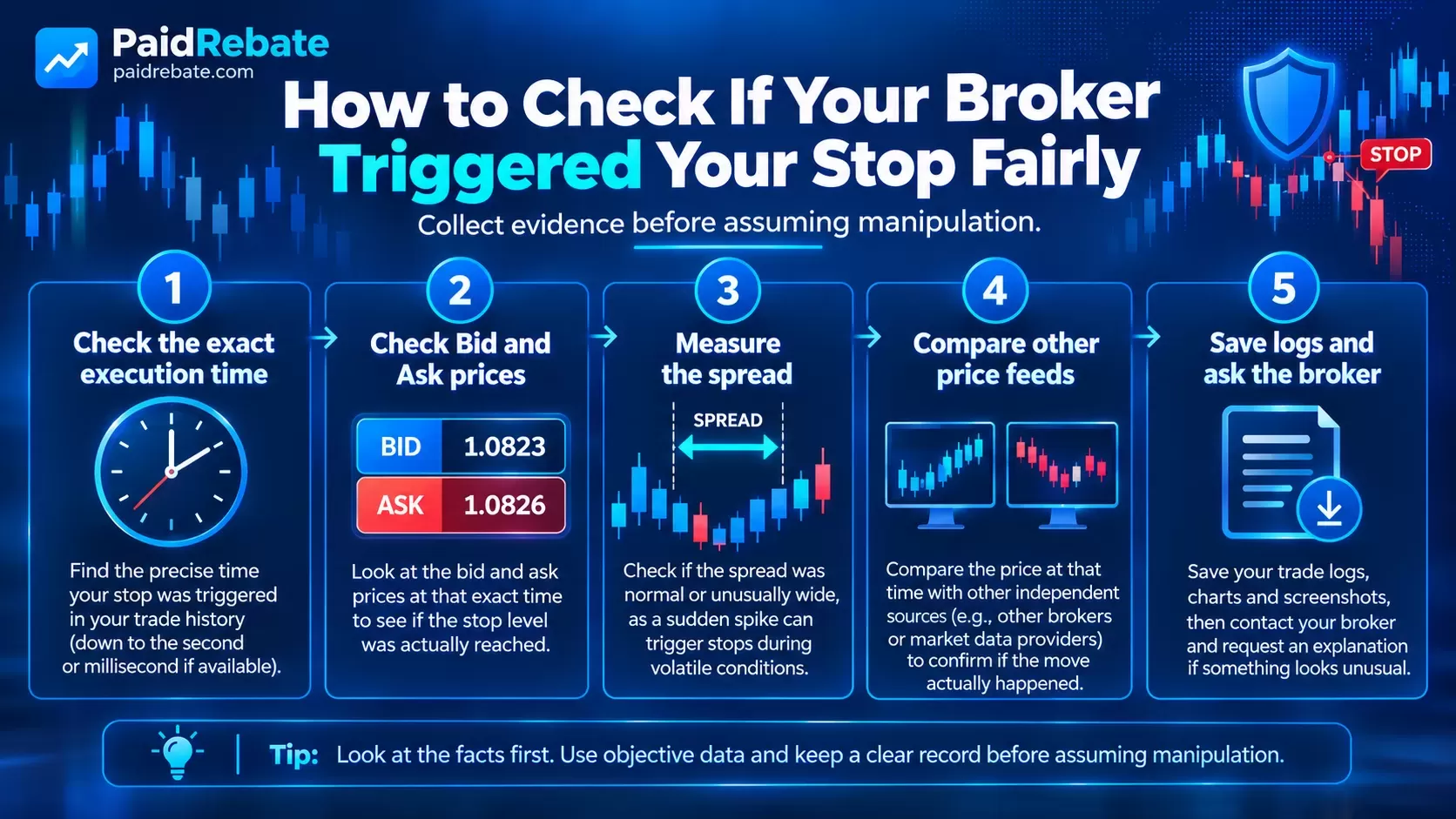
If a trade looks suspicious, don't begin with accusations.
Build an execution record first.
1. Record the trade details
Save the exact trade or position ID and execution timestamp.
2. Record your position
Note whether it was BUY or SELL and the exact Stop Loss level.
3. Check Bid and Ask
Look at both prices around the exact execution time.
4. Check the spread
Record the spread at the moment your Stop Loss triggered.
5. Compare independent sources
Check several credible price feeds using the same timestamp.
6. Review tick-level data
Don't rely only on a one-minute candle.
7. Check market events
Look for major economic announcements or unexpected market events.
8. Save platform logs
Keep relevant MT4, MT5, EA, VPS, or platform logs.
9. Ask the broker for an explanation
Provide the exact trade details and ask which price triggered the Stop Loss.
A useful broker inquiry should include:
-
Symbol
-
Position ID
-
Timestamp
-
Stop Loss price
-
Execution price
-
Reason for the dispute
Specific evidence is far more useful than simply saying:
"My broker hunted my Stop Loss."
Warning Signs Worth Investigating
One strange trade is rarely enough to establish anything.
Patterns matter more.
Pay closer attention if you repeatedly observe:
-
Isolated price spikes that cannot be found on comparable feeds
-
Consistently one-sided slippage
-
Unexplained execution delays
-
Frequent cancellation or repricing of profitable trades
-
Materially different execution after your trading becomes consistently profitable
-
Unclear responses to properly documented execution disputes
None of these automatically proves misconduct.
However, a repeated and measurable pattern can justify further investigation through the broker's complaints process and, where applicable, the relevant regulator or dispute-resolution body.
How to Reduce Avoidable Stop Loss Problems
You cannot eliminate execution risk completely.
But you can reduce unnecessary surprises.
Understand your Stop Loss trigger
Know whether your Stop Loss is triggered by Bid or Ask for the position you are trading.
Monitor the spread
A spread that looks normal during calm market conditions may widen significantly during news or rollover.
Consider volatility
Avoid automatically placing every Stop Loss just a few points beyond an obvious technical level.
Test execution
If precise execution is important to your strategy, consider testing a broker with smaller capital before increasing your account size.
Keep records
Serious traders measure execution quality just as carefully as they measure strategy performance.
Questions Worth Asking Your Forex Broker
Instead of asking only:
"Are you an ECN broker?"
Ask more specific questions:
-
Are you the legal counterparty to my transactions?
-
Do you internalize client exposure?
-
How do you handle positive and negative slippage?
-
Which price triggers Stop Loss orders?
-
How can spreads behave during volatile or low-liquidity conditions?
-
Can executed trades be repriced or cancelled?
-
Where can I find your order execution policy?
-
What evidence can I request if I dispute an execution?
These questions can reveal much more about an execution environment than a marketing label.
Stop Loss Hunting: Myth or Reality?
The phrase "Stop Loss hunting" is often used to describe several different phenomena.
Some apparent cases may simply be normal market mechanics, including:
-
Bid/Ask differences
-
Wider spreads
-
Slippage
-
Liquidity sweeps
-
Clusters of Stop Loss orders around obvious technical levels
Other disputes may involve genuine execution-quality concerns.
And historical regulatory cases have documented unfair trading practices involving asymmetric slippage.
So the most useful approach is neither:
"Every broker hunts stops."
nor:
"Broker manipulation never happens."
Instead, ask for the data.
What was the Bid?
What was the Ask?
What was the spread?
What did independent feeds show?
What does the broker's execution policy say?
What explanation did the broker provide?
Those questions can actually be investigated.
Frequently Asked Questions
Can my forex broker see my Stop Loss?
If you use a normal server-side Stop Loss, the broker's trading infrastructure generally has access to that instruction because it must manage and execute it.
Can my broker intentionally trigger my Stop Loss?
The fact that a broker can see a server-side Stop Loss does not prove intentional manipulation. Suspicious execution should be evaluated using Bid/Ask prices, spreads, timestamps, tick data, independent price sources, and execution records.
Why was my SELL Stop Loss triggered when the candle did not touch it?
One common explanation is that the chart displayed Bid prices while the SELL position's Stop Loss was triggered using Ask.
Can spread widening trigger a Stop Loss?
Yes. If the relevant Bid or Ask price reaches your Stop Loss because the spread widens, the position can trigger even if the other side of the quote barely moves.
Is B-Book execution illegal?
No. A broker acting as a counterparty or internally managing risk does not, by itself, establish misconduct. Disclosure, regulation, conflict management, pricing, and execution are the more relevant issues.
Is every price difference from TradingView suspicious?
No. Spot forex is decentralized, and brokers can use different liquidity providers, data feeds, aggregators, and spreads. Small differences are normal.
How can I investigate suspected broker manipulation?
Preserve the exact timestamp, Bid/Ask data, Stop Loss level, execution price, tick history, and platform logs. Compare the event across multiple credible sources and request a trade-specific explanation from the broker.
Final Thoughts
Yes, your forex broker may be able to see a normal server-side Stop Loss.
But that fact alone tells you very little about whether your Stop Loss was treated unfairly.
Forex execution involves several mechanics that can make a trade look suspicious when viewed only through a candle chart:
-
Bid and Ask prices
-
Floating spreads
-
Temporary liquidity shortages
-
Slippage
-
Rapid movements around concentrated order levels
At the same time, traders should not assume every execution is fair simply because a broker says it is.
Execution should be measurable.
Instead of asking only:
"Did my broker hunt my Stop Loss?"
ask:
"What happened to the Bid, Ask, spread, and execution at that exact moment?"
Then check the data.
That shift—from suspicion to evidence—is one of the most useful habits a retail trader can develop.
Sources & References
This article draws on primary regulatory and platform documentation, including U.S. Commodity Futures Trading Commission guidance on retail OTC forex and dealer counterparties, MetaTrader 5 documentation covering Stop Loss execution and Bid/Ask trigger mechanics, and National Futures Association records concerning the historical FXDD asymmetric-slippage case.
Disclaimer
This article is for educational and informational purposes only and does not constitute financial, investment, or legal advice. A Stop Loss trigger, unusual price movement, dealing-desk model, or B-Book structure does not by itself establish improper conduct. Execution models, contractual terms, and regulatory obligations differ between brokers, entities, and jurisdictions. Review your broker's official legal documents and execution policy when assessing a specific trade.
A passionate writer and content creator.
Community Comments
Please log in to comment on this blog post.
Log InNo comments yet. Be the first to comment!