
Best Times to Trade Forex: Understanding Market Sessions

The 24-Hour Forex Market
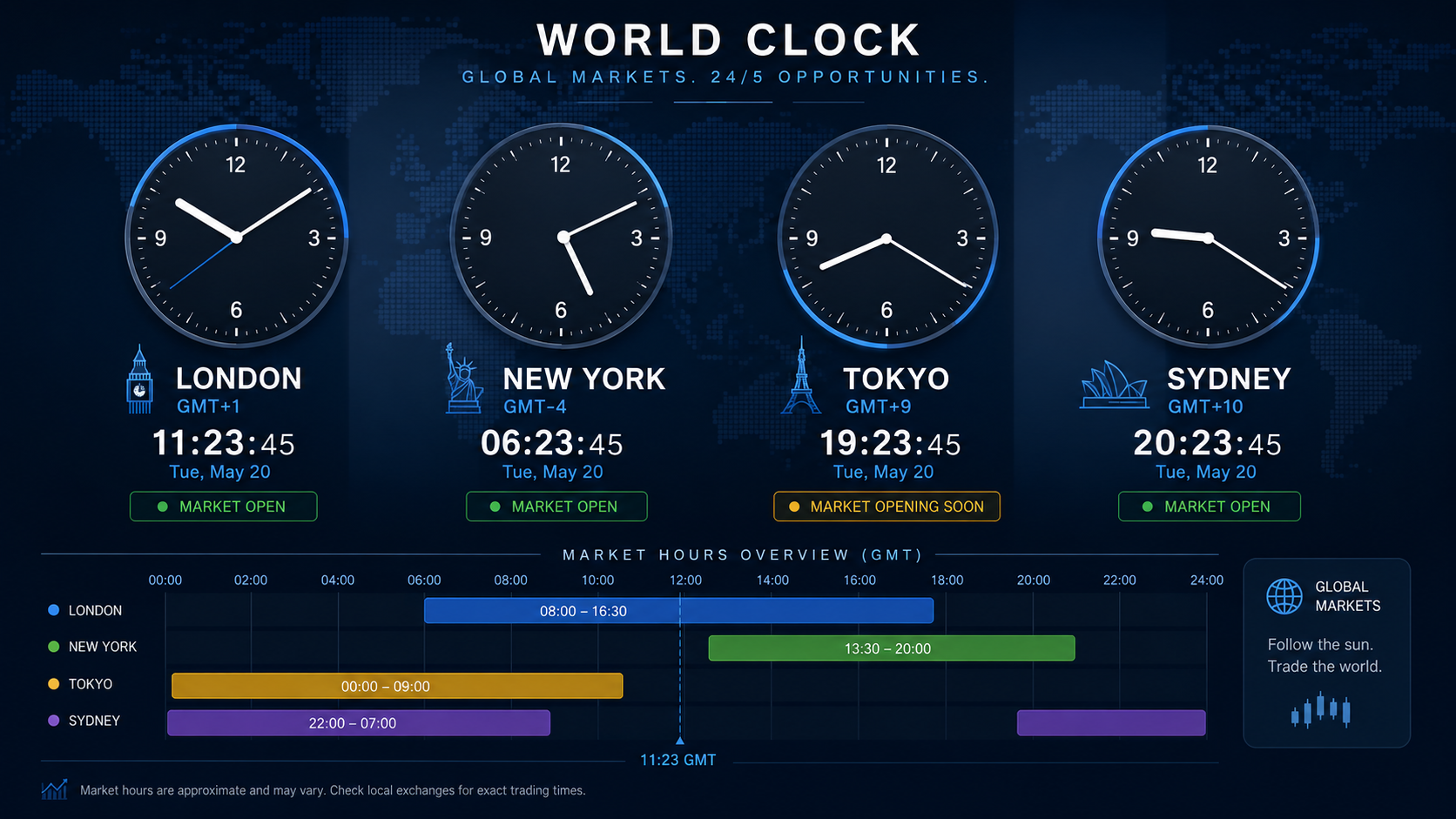
The forex market runs 24 hours a day, five days a week, across four major trading sessions. Each session has unique characteristics that affect volatility and liquidity. Unlike stock markets that open and close at specific times, the forex market is continuous — when one session closes, another immediately opens. This 24-hour structure means you can trade at virtually any time, but not all hours are created equal. Understanding the rhythms of each session and their overlaps is essential for choosing the best times to trade based on your strategy, schedule, and the currency pairs you trade.
The market week begins on Sunday at 5:00 PM EST when the Sydney session opens, and runs continuously until Friday at 5:00 PM EST when the New York session closes. Within this continuous flow, four major sessions — Sydney, Tokyo, London, and New York — dominate trading activity. Each session corresponds to the business hours of a major financial center, and the level of activity in each session depends on which banks, institutions, and traders are active at that time. The most important concept to understand is overlap: when two sessions are open simultaneously, trading volume and volatility increase dramatically.
The Four Major Sessions
- Sydney session (5:00 PM - 2:00 AM EST) — the quietest session, with lower volatility and wider spreads. Good for range trading AUD/USD and NZD/USD pairs, as Australian and New Zealand economic data drives movement. Best suited for traders who prefer calm market conditions and are comfortable with slower price action.
- Tokyo session (7:00 PM - 4:00 AM EST) — active for yen pairs (USD/JPY, EUR/JPY, GBP/JPY) with moderate volatility. Known for sharp moves during Japanese economic data releases. The Asian session often sets the tone for the rest of the day, and many institutional traders execute their initial positions during this period.
- London session (3:00 AM - 12:00 PM EST) — the highest volume session, accounting for approximately 35% of all forex trading. Tightest spreads, excellent liquidity, and consistent volatility across all major pairs. Most institutional trading occurs during London hours. This session is ideal for nearly every trading style.
- New York session (8:00 AM - 5:00 PM EST) — overlaps with London for four hours (8:00 AM - 12:00 PM EST), creating the most volatile and liquid period of the entire trading day. US economic data releases (Non-Farm Payrolls, CPI, GDP) typically occur during this session and cause significant market movement.
Session Overlaps: When the Action Happens
The London-New York overlap (8:00 AM - 12:00 PM EST) offers the best trading conditions with the highest liquidity, tightest spreads, and most consistent volatility. This is when the largest number of traders are active simultaneously, creating ideal conditions for both entry and exit. The Tokyo-London overlap (3:00 AM - 4:00 AM EST) is brief but can produce significant moves, particularly in yen pairs. Session transition periods — the gaps between when one session closes and another opens — tend to have lower liquidity and wider spreads, making them less ideal for trading. Plan your trading schedule around the overlaps for the best execution quality.
Best Times to Trade by Currency Pair
Different currency pairs are most active during different sessions. EUR/USD and GBP/USD are most volatile during the London and New York sessions, with the London-New York overlap producing the largest daily ranges. USD/JPY and EUR/JPY see the most action during the Tokyo session and the London-New York overlap. AUD/USD and NZD/USD are most active during the Sydney and Tokyo sessions, with additional movement during London hours when European news affects risk sentiment. USD/CAD responds strongly to Canadian economic data released during the New York session. Matching your trading hours to the active sessions for your preferred pairs dramatically improves your probability of success.
Session-Based Strategies
Scalpers and day traders prefer the London session for its tight spreads and consistent volatility — the rapid price movements provide frequent opportunities for small gains. Swing traders can use session closes to identify trends — the daily candle close at 5:00 PM EST is particularly important for determining market structure. News traders focus on the US session for high-impact data releases like NFP, FOMC decisions, and CPI reports. Breakout traders often target the London open (3:00 AM EST) and the New York open (8:00 AM EST), when fresh capital enters the market and new trading ranges are established. Position traders may find that lower-volatility sessions provide better risk-reward setups with wider stops and larger targets.
Conclusion
Understanding forex market sessions is essential for optimizing your trading results. Trade during the London-New York overlap for the best liquidity and tightest spreads. Match your trading hours to the sessions where your preferred currency pairs are most active. Choose a session that fits your schedule and trading style — scalpers need fast-moving London hours, while swing traders can succeed in calmer Asian sessions. Avoid low-liquidity transition periods and always check the economic calendar for high-impact events during your chosen session. When you align your trading with the market's natural rhythms, you give yourself the best possible chance of success.
A passionate writer and content creator.
Community Comments
Please log in to comment on this blog post.
Log InNo comments yet. Be the first to comment!